Cloud Alarms and Round-the-Clock Monitoring
Safety moves upstream when the platform notices a trend before an event. Automated linked response turns monitoring into action.
Key takeaways
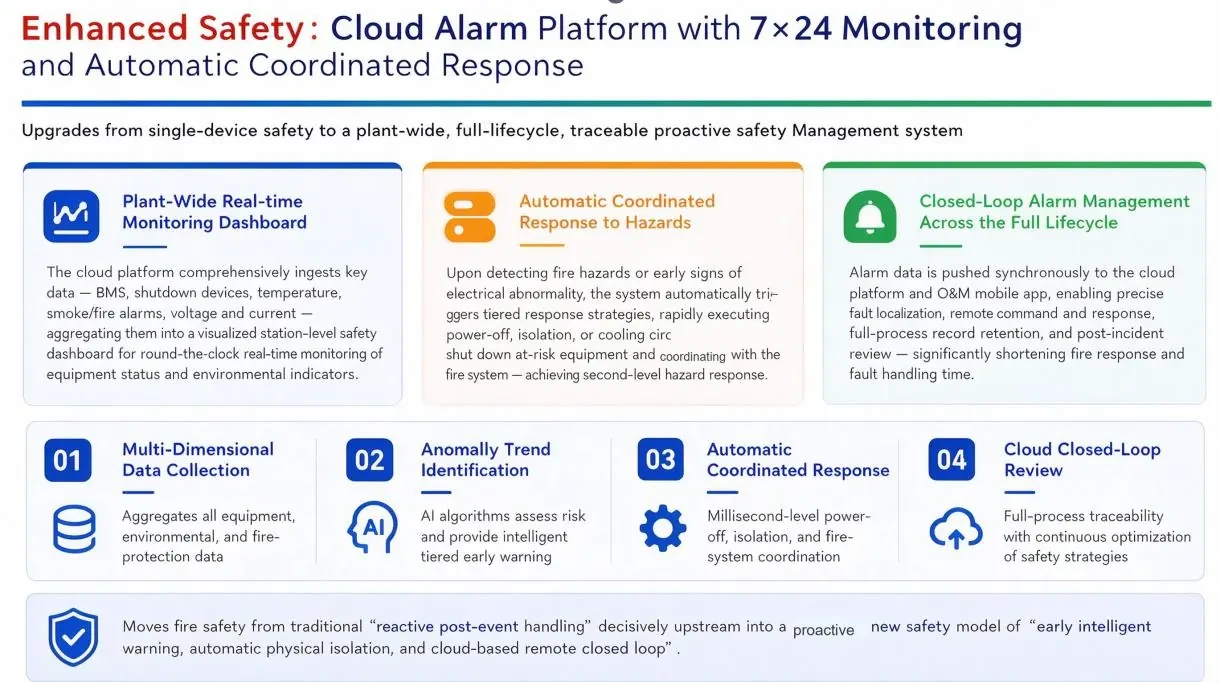
From reactive to proactive
Traditional fire safety waits for an event and then responds. A monitoring platform changes the sequence by detecting abnormal trends early, isolating affected hardware automatically and recording everything for review. The objective is to move the intervention upstream, from consequence management to condition management.
What the platform aggregates
Voltage, current, temperature, battery state of charge, breaker status and environmental sensors all report into a plant-level view. Aggregating these signals allows the platform to distinguish an isolated anomaly from a pattern affecting several adjacent units, which is often the earliest visible sign of a developing problem.
Automated linked response
On detecting an anomaly consistent with fire or an electrical fault, the platform triggers a tiered response: cut power to the affected scope, isolate or cool the circuit, stop associated equipment and notify the site fire system and responsible engineers. Handling measured in milliseconds removes dependence on a human noticing an alert at the right moment.
Closed-loop alarm control
Alarms are pushed to the cloud and to the operations team's mobile devices with a precise location, a suggested remote command and a full record. After the event, the same record supports review: what the platform saw, what it did and how long each step took. That audit trail is what turns an incident into an improvement.
Retention and review
Retention decisions should be explicit. Decide how long device-level telemetry, alarm history and command logs are kept, and make sure the retention period covers the plant's incident-review and warranty horizon. Data that has already been overwritten is of no use during a dispute, and storage of compact telemetry is inexpensive compared with reconstruction.
Measuring detection lead time
Track how long the platform takes to notice an emerging condition, not just how quickly it reports a failure. Lead time can be improved by tightening sampling on temperature and cell balance, and by screening for trends rather than only for thresholds. It is one of the few operational metrics that directly reduces the size of a potential event.
Defining escalation paths
Write down who is contacted for which condition, and at what hour. A high-temperature warning at a site with a resident engineer is a different event from the same warning at an unmanned array on a Sunday. Escalation rules keyed to site type prevent both over-reaction and the more damaging alternative, which is an alert that nobody acts on because the responsible party was never identified.
The four steps
Multi-dimensional data acquisition, anomaly-trend identification, automatic coordinated response, and cloud-based closed-loop review. Each step is measurable: reporting completeness, detection lead time, response latency and documentation coverage. Measuring them regularly is what keeps a monitoring system credible rather than decorative.
Want this analyzed for your plant?
Send your array data and we will return a technical view within one business day.
Literature search entries on Cloud EMS & Digital Management Platform
The entries below open literature search results rather than single papers, so the reading list can be filtered by date, citation count and full-text availability at the source. 24 queries across five indexes, grouped by source.
Google Scholar1
Semantic Scholar1
Baidu Scholar1
IEEE Xplore1
ScienceDirect1
OpenAlex19
- cloud-based energy management system renewable
- digital twin photovoltaic power station
- remote monitoring platform solar PV
- smart alarm linkage PV system
- cloud SCADA distributed energy resources
- artificial intelligence energy management solar
- predictive maintenance PV plant cloud
- big data analytics energy storage
- digital platform for distributed solar
- remote firmware update energy systems
- machine learning solar forecast
- cloud energy management renewable
- IOT monitoring photovoltaic plant
- digital twin energy system
- automated alarm solar plant
- web based SCADA renewable
- data security smart grid
- cloud services distributed generation
- remote optimization PV battery
Take the Numbers With You
The brochure covers the storage rod, the five safety layers, the gateway and the cloud platform. Download it, or send us your site conditions for a proposal within one business day.