The 48 V DC Case for Telecom Sites
Telecom equipment already runs on DC. Storing and delivering energy in the same domain removes conversion stages and simplifies the retrofit.
Key takeaways
- Base-station radios, transmission equipment and control units operate on minus forty-eight volts DC, supplied through rectifiers that convert mains alternating current.
- Even without a cabinet, check the surface that will carry the new generation and storage.
- Confirm the site's DC voltage arrangement, load profile, existing battery condition, available mounting surfaces and roof or ground structural capacity.
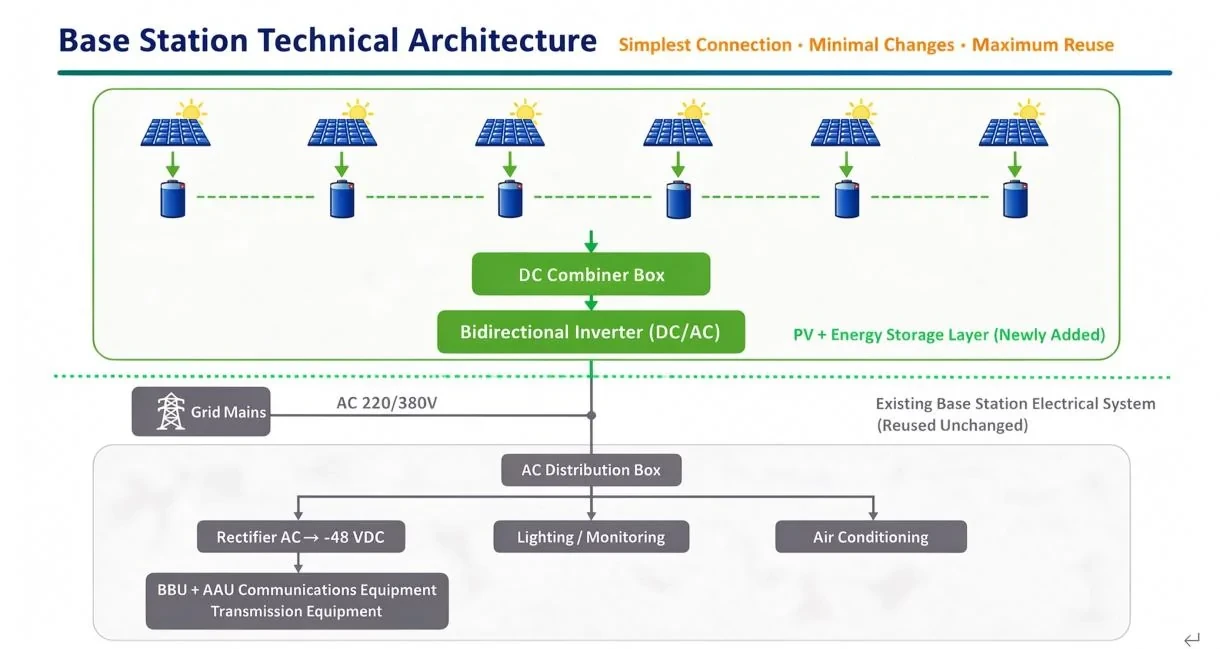
A DC-native load
Base-station radios, transmission equipment and control units operate on minus forty-eight volts DC, supplied through rectifiers that convert mains alternating current. [1]Because the load is already DC, generation and storage that deliver DC can serve it without another conversion, which raises efficiency and reduces the number of failure points in the supply chain.
Adding a layer rather than replacing one
The retrofit adds a photovoltaic and storage layer on top of the existing electrical system. [2]Mains input, the alternating current distribution box, the rectifiers, the radio equipment and the site's monitoring and cooling remain untouched. For a network operator, that means no re-certification of existing equipment and no interruption of service during construction.
Why this matters operationally
Sites in weak-grid areas rely on batteries that are stolen, degraded or simply undersized. [3]Distributed storage under the panels spreads the asset across the site, which reduces the value of any single theft and removes the single point of failure that a centralized battery bank represents. Modular units also let capacity grow as a site's load grows.
Load profile versus solar profile
A base station draws a roughly flat load through the day and night, while solar output peaks at noon. [4]Storage is what reconciles the two shapes: charging on midday surplus and discharging through evening and night, or during grid outages. Without storage, the surplus is exported or curtailed and the night load is bought from the grid or generated by diesel.
Roof and structure checks
Even without a cabinet, check the surface that will carry the new generation and storage. Confirm the structural capacity of the roof or the ground frame, verify the available area against the array layout, and note any wind exposure peculiarities. These checks are quick but they determine whether the site is straightforward or needs reinforcement.
Certification path for network acceptance
Network operators qualify equipment through their own process, which is often more demanding than a product certificate. Ask early which tests are required, who performs them, and what documentation the operator expects to retain. Starting that conversation in the design phase rather than at delivery is what keeps a network rollout on schedule.
Interfacing with existing rectifiers
The retrofit sits alongside the rectifier, not in place of it. Confirm the DC bus arrangement, the set point of the existing rectifier, and how the site behaves when solar and storage reduce the load the rectifier sees. Most sites are straightforward, but the interface should be described in writing, because a rectifier that idles at low load may behave differently from one operating near capacity all day.
What to check before proposing
Confirm the site's DC voltage arrangement, load profile, existing battery condition, available mounting surfaces and roof or ground structural capacity. Also confirm the operator's procurement and certification path, since network acceptance testing usually matters more than product specification in this segment.
Want this analyzed for your plant?
Send your array data and we will return a technical view within one business day.
How this argument is built
The piece on "The 48 V DC Case for Telecom Sites" moves through the steps below: the field problem, the mechanism behind it, and the quantities that decide the answer. Each step links to a literature search, so the reasoning can be checked against outside work rather than taken on trust.
- 01
A DC-native load
Base-station radios, transmission equipment and control units operate on minus forty-eight volts DC, supplied through rectifiers that convert mains alternating current.
Literature search on this step - 02
Adding a layer rather than replacing one
The retrofit adds a photovoltaic and storage layer on top of the existing electrical system.
Literature search on this step - 03
Why this matters operationally
Sites in weak-grid areas rely on batteries that are stolen, degraded or simply undersized.
Literature search on this step - 04
Load profile versus solar profile
A base station draws a roughly flat load through the day and night, while solar output peaks at noon.
Literature search on this step
Figures quoted in the text come from Kingneed's own product reference pack. External links open search results across public indexes rather than single papers, and are meant for verification, not endorsement. Jump to the full reading list (28 queries).
Literature search entries on Telecom Base Station Green-Power Solution
Numbered entries correspond to the footnote markers in the article above. Each opens a literature search rather than a single paper, so the reading list can be filtered by date, citation count and full-text availability at the source. 24 queries across five indexes, grouped by source.
Claim-level searches cited in the text
- [1]base-station radios transmission equipment control units operate
- [2]retrofit adds photovoltaic storage layer existing electrical
- [3]sites weak-grid areas rely batteries stolen degraded
- [4]base station draws roughly flat load night
Each entry is built from the sentence that carries the marker, so the number in the text and the query here refer to the same claim. Entries further down the list cover the wider topic.
Google Scholar1
Semantic Scholar1
Baidu Scholar1
IEEE Xplore1
ScienceDirect1
OpenAlex19
- [10]PV diesel hybrid telecom base station
- [11]48V DC microgrid telecommunication
- [12]solar power system telecom tower
- [13]energy management telecom base station 5G
- [14]green power supply base station feasibility
- [15]telecom power supply renewable hybrid
- [16]5G base station solar battery
- [17]diesel generator optimization telecom
- [18]DC power system telecom site
- [19]energy efficiency telecom network
- [20]base station photovoltaic system
- [21]off-grid telecom renewable power
- [22]lithium battery telecom tower
- [23]hybrid power supply telecommunication
- [24]solar powered remote telecom
- [25]green energy base station
- [26]battery backup telecom system
- [27]photovoltaic diesel hybrid telecom
- [28]DC microgrid telecom application
Take the Numbers With You
The brochure covers the storage rod, the five safety layers, the gateway and the cloud platform. Download it, or send us your site conditions for a proposal within one business day.