Where DC Arc Faults Come From
Series arcs grow from ordinary wear. Understanding their origin is what makes detection and shutdown design decisions rather than afterthoughts.
Key takeaways
- DC arc faults rarely begin with a dramatic failure.
- Detection reduces the consequence of a fault; inspection reduces the chance of one forming.
- Relevant standards for this class of product include an electrical safety certification for the equipment and environmental qualification for outdoor mounting.
The ordinary causes
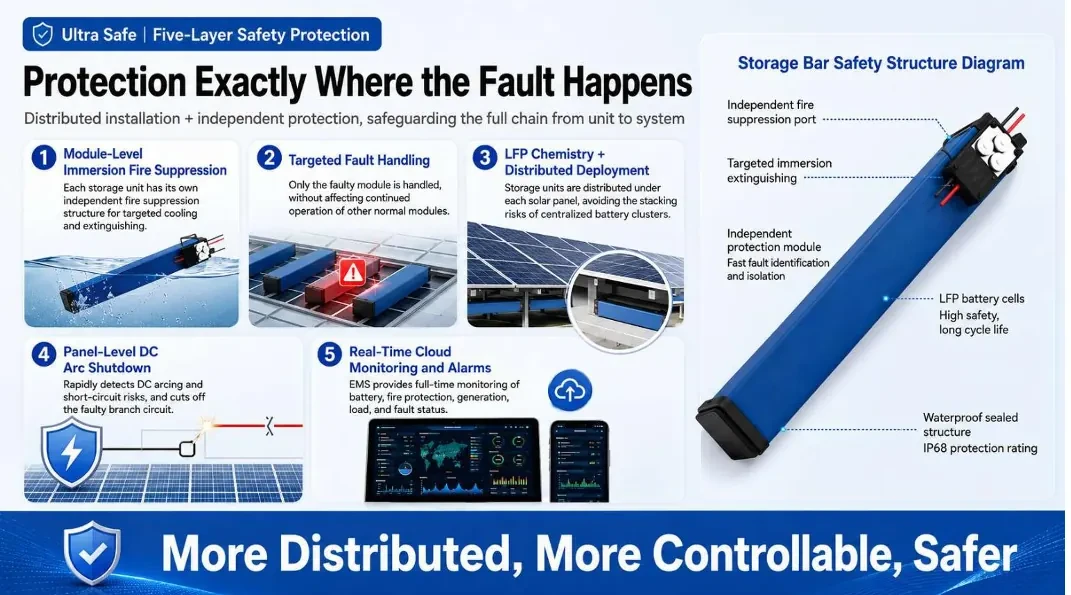
DC arc faults rarely begin with a dramatic failure. Loose connectors after years of thermal cycling, insulation damaged during earlier maintenance, a partially seated plug, corrosion at a junction, a rodent-chewed conductor: each creates a small gap where current continues to flow through air. Industry assessments attribute a large share of PV plant fires to DC-side faults of this kind.
Why strings run hot
A string can carry up to a thousand volts on the DC side. At that potential, a degraded connection has enough energy available to sustain an arc once it forms. Detection therefore needs to compare fast changes in current and voltage against a model of normal operation, and it needs to act before the arc damages the conductor and spreads.
Detection at the module level
Protection placed in the enclosure under each module is physically close to where faults happen. That proximity shortens the distance between an event and the device that can isolate it, and it means a fault in one row does not require the plant's whole protection scheme to interpret a small signature among larger currents.
Multi-level shutdown
A practical design supports several isolation scopes: the whole string, a single inverter's input, or a sub-array. The device that detects the event can therefore command the smallest action that makes the situation safe, which limits the generation impact of a nuisance trip while still removing the hazard.
Scheduled inspection still matters
Detection reduces the consequence of a fault; inspection reduces the chance of one forming. Keep a written inspection interval covering connectors, cable support, seals and visible corrosion, and record findings row by row. In practice the inspection record tells you whether the environment is degrading the array faster than expected, which informs both maintenance budgets and warranty discussions.
Documenting the detection chain
Write down what senses an event, what decides, what acts and how long each step takes. Include the behaviour when the communication link is unavailable, because a protection function that depends on the cloud is not a protection function. This one-page description answers most technical due-diligence questions about DC-side safety before they are asked.
Choosing a test programme
Arc detection can be validated by injecting a controlled fault signature and confirming that the device identifies it within the specified time. Ask what test setup was used, at what current and voltage, and whether the results are documented per unit or per batch. A test method described in writing allows the buyer's own engineers to assess whether the claim applies to their operating conditions.
Standards and evidence
Relevant standards for this class of product include an electrical safety certification for the equipment and environmental qualification for outdoor mounting. Ask for the certificate, the arc-detection test method and the measured shutdown time, and ask how the device behaves if the communication link is unavailable. Those four answers define the real safety posture.
Want this analyzed for your plant?
Send your array data and we will return a technical view within one business day.
Literature search entries on Five-Layer Safety & DC Arc Rapid Shutdown
The entries below open literature search results rather than single papers, so the reading list can be filtered by date, citation count and full-text availability at the source. 24 queries across five indexes, grouped by source.
Google Scholar1
Semantic Scholar1
Baidu Scholar1
IEEE Xplore1
ScienceDirect1
OpenAlex19
- DC arc fault detection photovoltaic rapid shutdown
- lithium ion battery thermal runaway propagation
- PV DC arc fault protection standard
- distributed battery system safety design
- rapid shutdown device NEC requirements
- battery protection circuit PV
- arc fault circuit interrupter DC
- PV rapid shutdown UL3741
- thermal runaway prevention lithium battery
- system safety certification photovoltaic
- DC arc detection algorithm
- overcurrent protection PV system
- insulation monitoring DC microgrid
- lithium iron phosphate safety tests
- ground fault protection solar array
- battery thermal management design
- UL 9540 energy storage safety
- NEC 2017 rapid shutdown
- spark detection photovoltaic system
Take the Numbers With You
The brochure covers the storage rod, the five safety layers, the gateway and the cloud platform. Download it, or send us your site conditions for a proposal within one business day.