DC Has No Zero Crossing: A Fire-Risk Primer
Alternating current extinguishes itself a hundred times a second. Direct current does not, which is why DC arc protection deserves separate attention.
Key takeaways
The physics in one paragraph
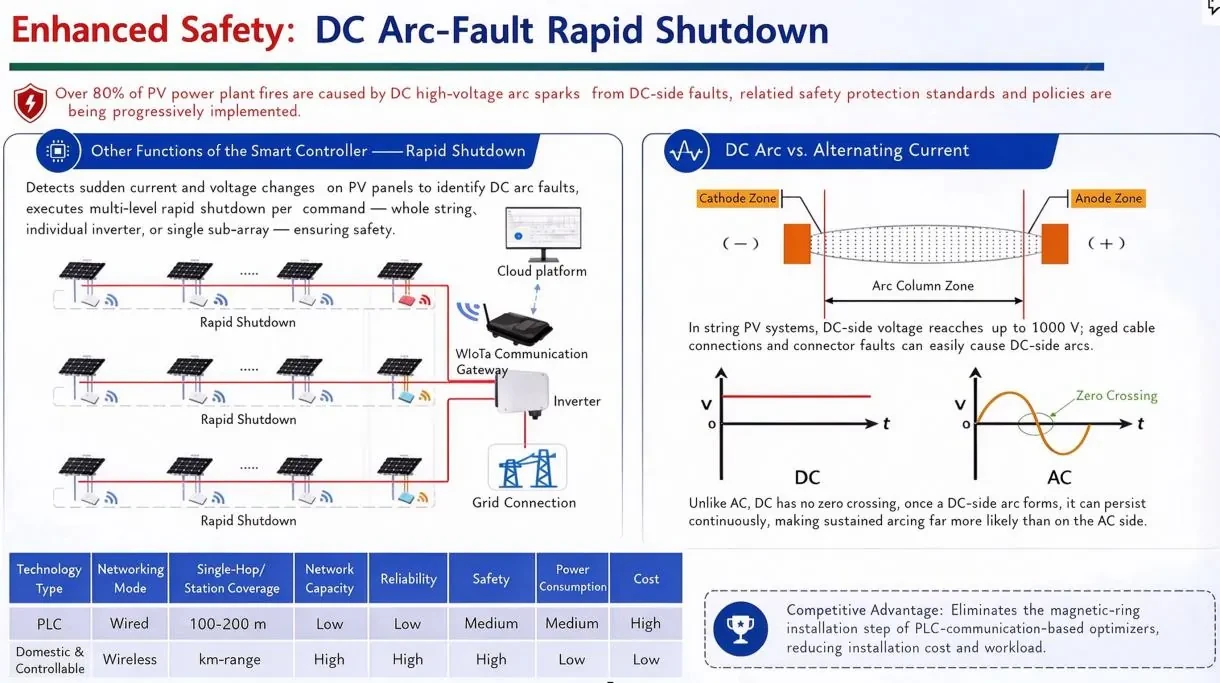
In an AC circuit, current passes through zero twice per cycle. An arc that forms is repeatedly interrupted and must restrike. In a DC circuit, current flows in one direction continuously, so once an arc establishes itself it can persist. The practical consequence is that a DC arc is more likely to be sustained than an AC arc of similar magnitude.
Why ageing matters more on the DC side
DC-side conductors and connectors experience years of thermal cycling, ultraviolet exposure and mechanical stress from wind and thermal movement. Contact resistance rises gently before it becomes visible, and the resulting heating further degrades the joint. The failure mode develops slowly and then presents suddenly, which is why scheduled inspection and early detection both matter.
What shutdown must achieve
The goal of rapid shutdown is to bring the DC conductors to a safe voltage after the device acts. In this product class, output falls below two volts and the specified shutdown time is under two seconds, with the isolation impedance documented. That performance is what allows responders to work near the array in a genuinely de-energized condition.
Standards context
Several markets have introduced requirements for module-level shutdown or arc-fault protection, and insurers increasingly ask about both. Retrofitting a plant with per-module protection therefore does two things at once: it improves safety and it improves the plant's position on future compliance questionnaires.
Comparing consequences, not adjectives
Safety differences are most usefully described in terms of what one failure can reach. Compare energy per node, separation between nodes, series cell count and isolation time, side by side, rather than trading words such as robust or enhanced. Numbers of that kind survive technical review and can be verified from a data sheet and a test report.
Regulatory direction of travel
Requirements for module-level shutdown and arc-fault protection have been spreading across markets, and insurers increasingly reference them in surveys and renewal questionnaires. A plant retrofitted with per-module protection is better placed for those changes than one that is not, which makes the safety investment partly a forward-compliance decision rather than a purely technical one.
Retrofitting an older array safely
Older arrays bring their own considerations: connectors at the end of their service life, insulation that has hardened, labelling that no longer matches the layout. Survey the affected rows before work begins and replace obviously degraded connectors as part of the scope rather than working around them. Adding new hardware to a deteriorated connection set is the fastest way to introduce the fault the retrofit is meant to manage.
How to discuss risk with a buyer
Avoid absolute claims. No protection scheme can promise that no incident will ever occur. The defensible statement is structural: energy is dispersed across many small nodes instead of concentrated in one, faults are isolated close to their origin, and shutdown has been measured. That is what an engineering reviewer will accept after scrutiny.
Want this analyzed for your plant?
Send your array data and we will return a technical view within one business day.
Literature search entries on Five-Layer Safety & DC Arc Rapid Shutdown
The entries below open literature search results rather than single papers, so the reading list can be filtered by date, citation count and full-text availability at the source. 24 queries across five indexes, grouped by source.
Google Scholar1
Semantic Scholar1
Baidu Scholar1
IEEE Xplore1
ScienceDirect1
OpenAlex19
- DC arc fault detection photovoltaic rapid shutdown
- lithium ion battery thermal runaway propagation
- PV DC arc fault protection standard
- distributed battery system safety design
- rapid shutdown device NEC requirements
- battery protection circuit PV
- arc fault circuit interrupter DC
- PV rapid shutdown UL3741
- thermal runaway prevention lithium battery
- system safety certification photovoltaic
- DC arc detection algorithm
- overcurrent protection PV system
- insulation monitoring DC microgrid
- lithium iron phosphate safety tests
- ground fault protection solar array
- battery thermal management design
- UL 9540 energy storage safety
- NEC 2017 rapid shutdown
- spark detection photovoltaic system
Take the Numbers With You
The brochure covers the storage rod, the five safety layers, the gateway and the cloud platform. Download it, or send us your site conditions for a proposal within one business day.