Communication cabling is a hidden cost in every distributed retrofit. A self-organizing mesh removes the trench, the conduit and the connectors.
Key takeaways
- A distributed control scheme normally implies a communication network: conduit along the rails, junction boxes, connectors at every device and a wiring schedule that has to survive a deca...
- Without a communication cable, the installation sequence changes: units are mounted and powered, then the mesh is given time to form and each device is confirmed as visible before the cre...
- Before a rollout, verify packet loss and latency at the farthest row, check behaviour with a gateway offline, and confirm that the site's own radio environment does not interfere.
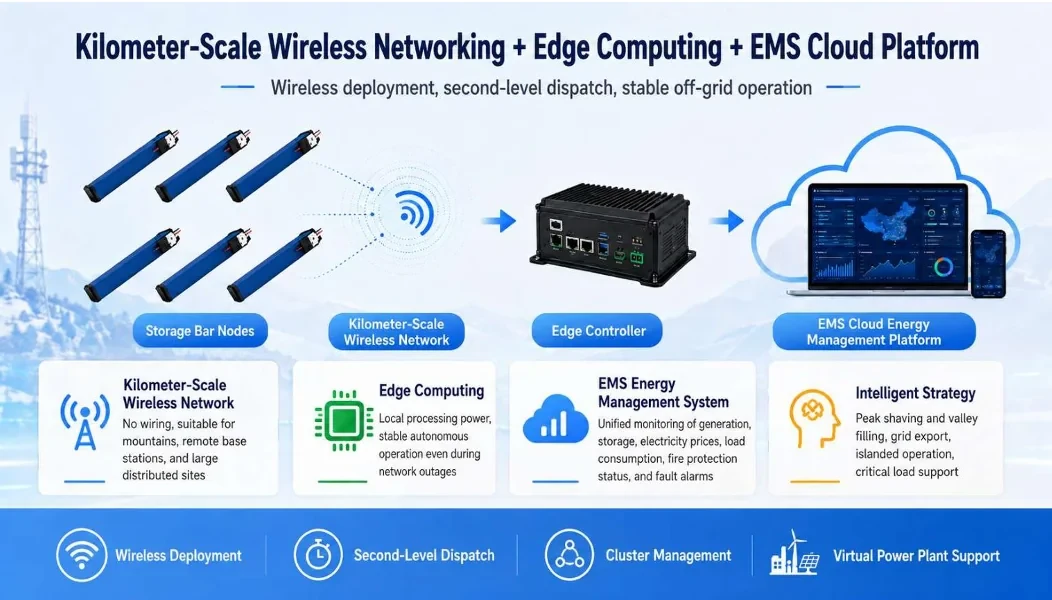
The cabling problem
A distributed control scheme normally implies a communication network: conduit along the rails, junction boxes, connectors at every device and a wiring schedule that has to survive a decade outdoors. On a large array that is a substantial bill of materials and a substantial labor line, and every added connector is a potential water ingress point.
How the mesh behaves
Each rod carries a radio and joins a self-organizing network, forwarding messages toward the nearest gateway. There is no fixed topology to design and no single cable whose failure silences a zone. Range is measured in kilometres per hop, and devices route around obstructions such as inverters, transformers and site buildings rather than requiring a line of sight.
Measured field performance
On a deployed fleet of seventeen hundred and fifty units, the reported coverage radius was two kilometres, with fourteen bytes per unit per report and about twenty seconds from device to gateway for a full telemetry set covering temperature, voltage, current, power, state of charge and tracking status. Dispatch commands reached units in one to three seconds, which is fast enough for price or weather-response changes.
Scale and resilience
A single gateway is specified to carry tens of thousands of terminals, and carrier-class hardware extends that further. Traffic is small because each report is compact, so the constraint is coverage rather than bandwidth. If a link degrades, the mesh reroutes; if a device goes offline, its last state remains visible in the platform until it reports again.
Installation implications of no cabling
Without a communication cable, the installation sequence changes: units are mounted and powered, then the mesh is given time to form and each device is confirmed as visible before the crew leaves the row. Verification is therefore a radio check rather than a continuity test, and the commissioning record should capture signal quality at the farthest unit of each section.
Firmware and security questions
Ask how firmware is delivered, whether it is signed, what happens to a device that fails mid-update, and whether the radio link can be used to reach anything other than the manufacturer's platform. These questions matter more as a fleet ages, because an unattended network of thousands of radios is only as safe as its update process.
Interference in dense industrial sites
Substations, variable-speed drives, welding plant and dense metalwork all create radio noise. Before a rollout, survey the site with a portable receiver at representative rows and during daytime operations rather than at a quiet hour. Where interference is structural, additional gateways shorten the paths between devices, and the survey results tell you where they are needed before the first unit is installed.
What to test on site
Before a rollout, verify packet loss and latency at the farthest row, check behaviour with a gateway offline, and confirm that the site's own radio environment does not interfere. Document these three results: they answer most of the technical objections a telecom or utility buyer will raise about wireless control in an industrial setting.
Want this analyzed for your plant?
Send your array data and we will return a technical view within one business day.
Literature search entries on System Architecture & Wireless Mesh Networking
The entries below open literature search results rather than single papers, so the reading list can be filtered by date, citation count and full-text availability at the source. 24 queries across five indexes, grouped by source.
Google Scholar1
Semantic Scholar1
Baidu Scholar1
IEEE Xplore1
ScienceDirect1
OpenAlex19
- wireless mesh network photovoltaic monitoring
- large scale IoT wireless energy management
- self-organizing mesh protocol distributed energy
- module-level communication PV plant
- second-level response PV storage control
- wireless communication protocols microgrid
- network topology large PV plant
- IoT data acquisition solar farm
- self-healing mesh energy network
- Zigbee based photovoltaic monitoring
- LoRa wireless monitoring PV
- mesh network distributed energy resources
- sensor network large scale solar
- daisy-chain communication PV module
- wireless battery management system
- remote monitoring solar microgrid
- bluetooth mesh PV plant
- cloud based data acquisition photovoltaic
- network reliability PV communication
Take the Numbers With You
The brochure covers the storage rod, the five safety layers, the gateway and the cloud platform. Download it, or send us your site conditions for a proposal within one business day.