Optimization, storage, shutdown and networking sit in the same enclosure. Integrating them removes both cost and coordination from a retrofit.
Key takeaways
- A conventional retrofit could reach a similar outcome by buying three separate products: an optimizer per module, a rapid shutdown device per string, and storage somewhere else with its o...
- Integration also removes optionality, and that should be acknowledged.
- Each rod carries a radio and joins a self-organizing mesh that reports to a gateway.
Why integration matters commercially
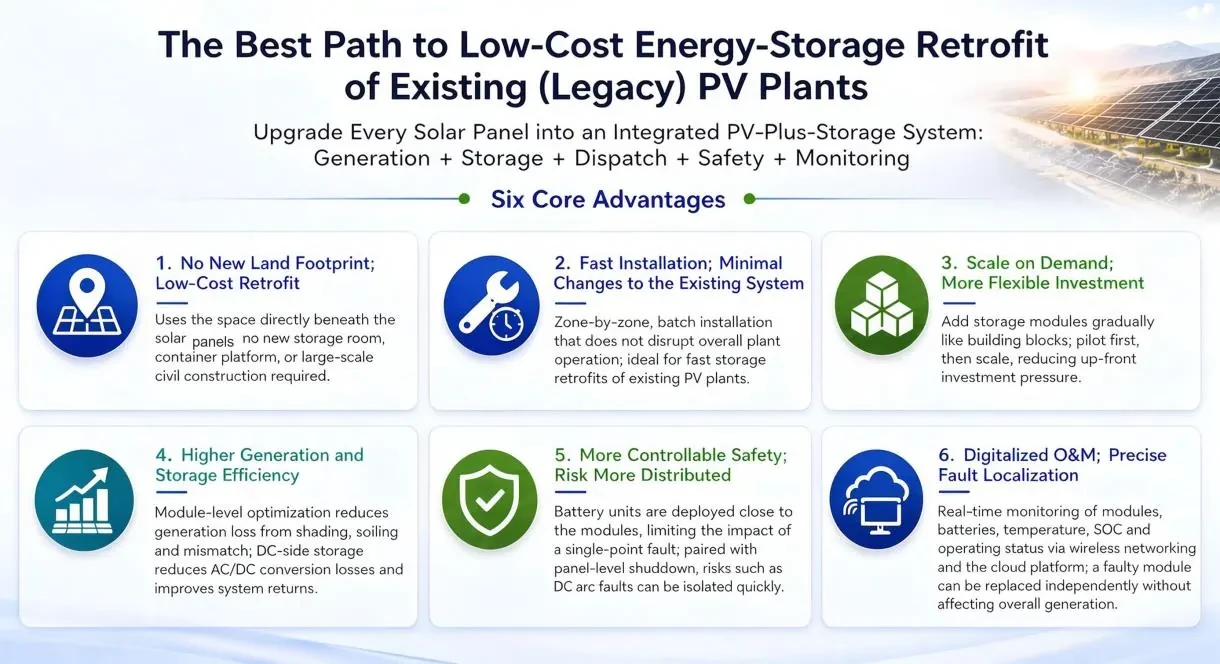
A conventional retrofit could reach a similar outcome by buying three separate products: an optimizer per module, a rapid shutdown device per string, and storage somewhere else with its own wiring. Each purchase brings its own enclosure, its own certification file, its own commissioning step and its own supplier to coordinate. Integration collapses four scopes into one bid and one installation.
Function one: tracking
The built-in tracker holds each module at its own maximum power point. This removes the drag that a shaded or soiled panel exerts on its string, and it recovers output that a single string-level stage cannot resolve. In practice this is the function that pays back first, because it works on every sunny hour rather than only during peak windows.
Function two: storage
The same enclosure holds cells and a DC-to-DC stage. Midday surplus is stored locally and released in the evening peak or when the grid asks for power. Because capacity is added a rod at a time, storage size becomes a purchase decision that can be revisited after a season of measured data rather than a fixed assumption made during design.
Function three: shutdown
A rapid shutdown device detects DC arcs and drops output voltage to a safe level on command or on fault. Because it is per rod, isolation happens at the module level rather than at the string, which shortens the path between detection and a de-energized conductor. Output voltage under shutdown is specified below two volts, with millisecond-class command handling.
What integration costs to lose
Integration also removes optionality, and that should be acknowledged. A buyer who wants one supplier's optimizer and another's battery cannot do so here. The trade is deliberate: fewer interfaces, fewer warranty boundaries and one point of accountability, in exchange for accepting a single vendor's roadmap for all four functions in the enclosure.
Serviceability as a design goal
Because the four functions share an enclosure, serviceability has to be designed in from the start. Connectors are accessible without removing the module, addresses are readable without opening the case, and a unit can be isolated and replaced while its neighbours keep running. Those three properties are what make a distributed fleet maintainable at all.
Failure isolation across functions
Sharing one enclosure across four functions raises a fair question: does a fault in one function disable the others? A practical design keeps them separable. Tracking can pass energy through with a bypass path, shutdown remains available independently of the storage stage, and the radio reports even when the battery is offline. Asking how each function behaves when another fails is a useful test of the integration claim.
Function four: networking
Each rod carries a radio and joins a self-organizing mesh that reports to a gateway. There is no communication cabling across the array, so the retrofit adds no signal trench and no extra conduit on the rail. Status, temperature, state of charge and dispatch commands travel over the same radio link, which also delivers firmware updates to units already installed.
Want this analyzed for your plant?
Send your array data and we will return a technical view within one business day.
Literature search entries on Technical Specifications (Full Datasheet)
The entries below open literature search results rather than single papers, so the reading list can be filtered by date, citation count and full-text availability at the source. 24 queries across five indexes, grouped by source.
Google Scholar1
Semantic Scholar1
Baidu Scholar1
IEEE Xplore1
ScienceDirect1
OpenAlex19
- IEC 62109 safety standard photovoltaic inverter
- DC optimizer specification PV module
- IP65 enclosure photovoltaic electronics
- battery cycle life LFP 6000
- MC4 connector photovoltaic system standard
- photovoltaic connector standards
- battery temperature range specifications
- converter efficiency measurement method
- photovoltaic system EMC standards
- inverter power rating testing
- IP65 rating solar inverter
- IEC 62109 photovoltaic inverter
- UL 1741 inverter interconnection
- lithium battery cycle life testing
- MC4 connector compatibility
- photovoltaic DC cable standard
- inverter restart time standard
- operating temperature range solar electronics
- CE certification PV equipment
Take the Numbers With You
The brochure covers the storage rod, the five safety layers, the gateway and the cloud platform. Download it, or send us your site conditions for a proposal within one business day.