From Array to Cloud: The Role of the Gateway
The gateway is where local control meets remote visibility. Its design decides what the platform can do when the network is unavailable.
Key takeaways
- The gateway collects reports from the mesh, normalizes them and back-hauls to the cloud over fiber or another available link.
- The gateway's uplink is the part most likely to be unavailable at a remote tower or mine.
- When specifying a gateway, ask about maximum terminal count, supported back-haul options, offline retention, firmware management and how a device is re-homed if a gateway is replaced.
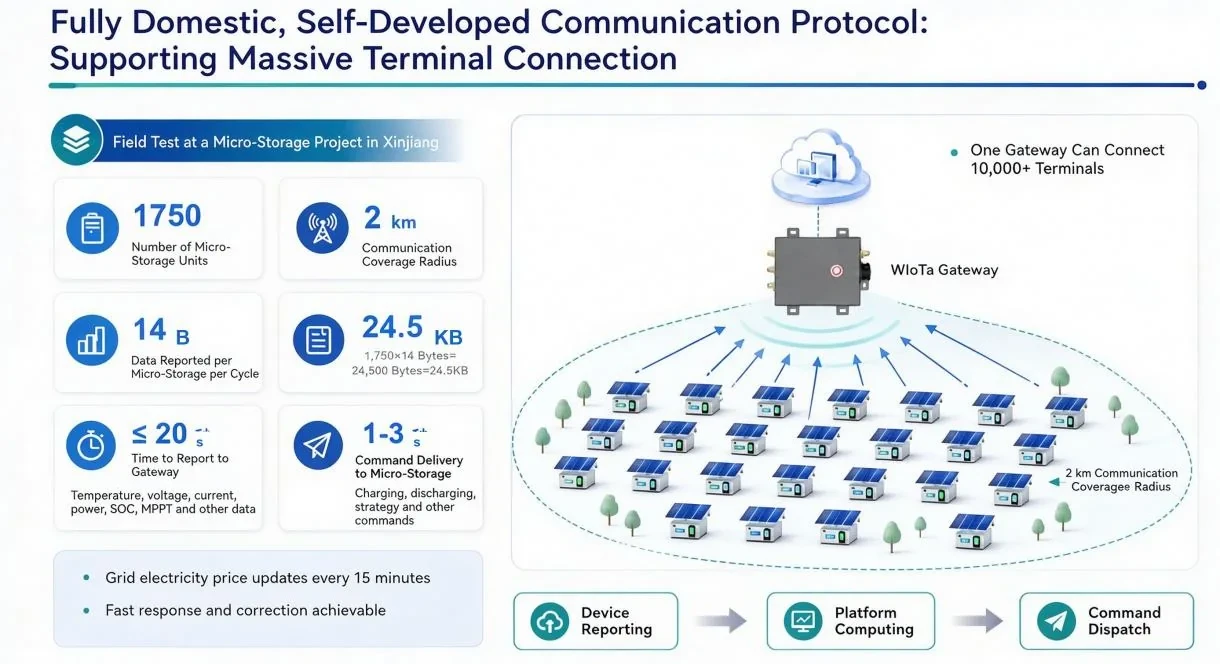
Aggregation and translation
The gateway collects reports from the mesh, normalizes them and back-hauls to the cloud over fiber or another available link. It also holds local strategy logic, so charge and discharge decisions do not depend on round trips to a data centre. That split between local execution and remote supervision is what keeps dispatch responsive when connectivity is intermittent.
Local autonomy as a design choice
If the back-haul drops, rods continue to run their last valid strategy locally. Surplus is still stored, evening discharge still happens, and protective functions never depend on the cloud. When the link returns, the gateway reconciles the backlog and republishes state. For an operator, this means a network outage degrades visibility rather than availability.
Protocol and data volume
The communication protocol is proprietary and documented, designed for high device counts rather than high throughput. Reports are compact, which is why thousands of units fit comfortably within a modest link budget. Grid price updates can refresh every fifteen minutes, and fast response corrections can be pushed at short notice when tariffs or dispatch signals change.
Edge computing in practice
Putting a small amount of intelligence at the edge improves both latency and data quality. Aggregated statistics, anomaly screening and event filtering happen locally, so the platform receives meaningful state changes instead of raw noise. Operators see faster alarms and less bandwidth consumed by routine reporting.
Back-haul options on remote sites
The gateway's uplink is the part most likely to be unavailable at a remote tower or mine. Confirm which options the platform supports, whether cellular or satellite links can be used, and how much data a full fleet report consumes per day. Estimating that volume against an existing data plan is a practical step many projects skip until the first bill arrives.
What happens after a gateway failure
Devices continue executing their last valid strategy, so generation and storage keep working while visibility is lost. The operational question is recovery: how a replacement gateway adopts existing devices, whether addresses are preserved, and how long the backlog takes to reconcile. Ask for that procedure in writing before deployment, not during an outage.
Cybersecurity responsibilities
A monitored fleet is an industrial control system, and it should be treated as one. Establish who holds platform credentials, how accounts are removed when staff leave, whether remote commands require authorisation and where logs are stored. Those four questions are usually answered by the platform vendor, but the responsibility for enforcing them stays with the operator, and it belongs in the operating procedure rather than in the contract only.
Selection criteria
When specifying a gateway, ask about maximum terminal count, supported back-haul options, offline retention, firmware management and how a device is re-homed if a gateway is replaced. Those five answers determine whether the platform remains a management tool or becomes an operational dependency nobody can maintain.
Want this analyzed for your plant?
Send your array data and we will return a technical view within one business day.
Literature search entries on Cloud EMS & Digital Management Platform
The entries below open literature search results rather than single papers, so the reading list can be filtered by date, citation count and full-text availability at the source. 24 queries across five indexes, grouped by source.
Google Scholar1
Semantic Scholar1
Baidu Scholar1
IEEE Xplore1
ScienceDirect1
OpenAlex19
- cloud-based energy management system renewable
- digital twin photovoltaic power station
- remote monitoring platform solar PV
- smart alarm linkage PV system
- cloud SCADA distributed energy resources
- artificial intelligence energy management solar
- predictive maintenance PV plant cloud
- big data analytics energy storage
- digital platform for distributed solar
- remote firmware update energy systems
- machine learning solar forecast
- cloud energy management renewable
- IOT monitoring photovoltaic plant
- digital twin energy system
- automated alarm solar plant
- web based SCADA renewable
- data security smart grid
- cloud services distributed generation
- remote optimization PV battery
Take the Numbers With You
The brochure covers the storage rod, the five safety layers, the gateway and the cloud platform. Download it, or send us your site conditions for a proposal within one business day.