Inverter replacement is the quiet deal-breaker in many retrofit budgets. Panel-mounted storage is designed to leave it alone.
Key takeaways
- Changing the central inverter is rarely just an equipment swap.
- Ask the original inverter manufacturer three things: the accepted DC input voltage range, the maximum short-circuit current the input can tolerate, and whether adding a device between mod...
- Keeping the inverter preserves the site's operating history and its relationship with grid operators.
Why inverters dominate retrofit risk
Changing the central inverter is rarely just an equipment swap. It can implicate protection settings, grid-connection agreements, warranty arrangements with the original supplier and the plant's history of certified performance. On mature sites, the administrative effort alone can exceed the cost of the hardware, which is why inverter-related scope so often ends a retrofit in the feasibility stage.
How the retrofit avoids it
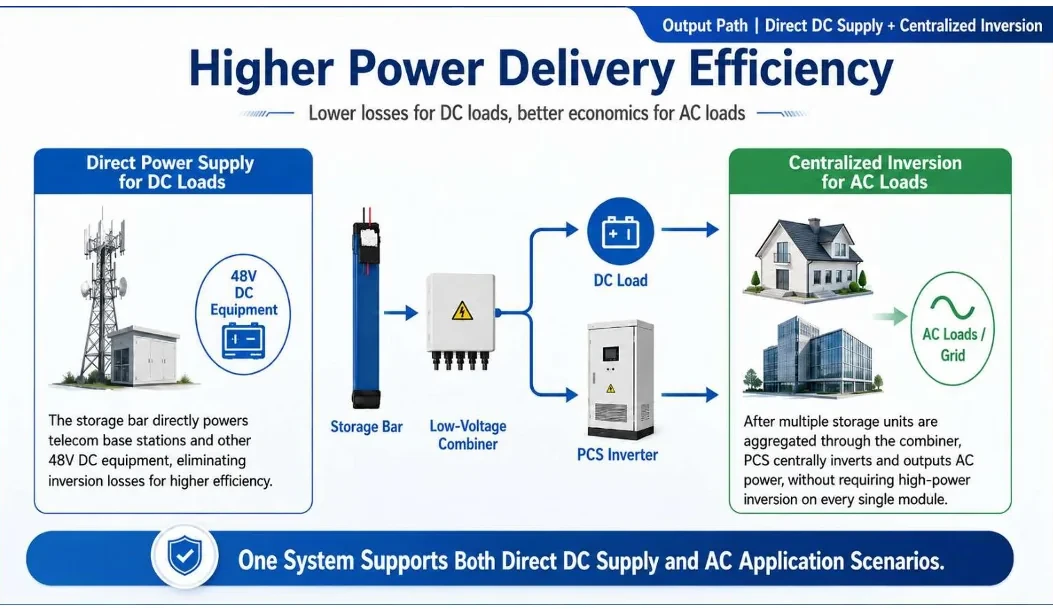
Panel-mounted storage works downstream of the array and upstream of the existing inverter. It modifies the current and voltage conditions the inverter sees, but not its role: the inverter still converts, still tracks grid conditions and still holds the interconnection. Nothing about the plant's grid-facing equipment needs to change.
Two delivery paths
Energy can leave the storage rod in one of two ways. It can feed a 48 V DC load directly, which suits telecom sites and other DC-native equipment, or it can pass through the plant's inverter to the grid. The choice is a configuration decision rather than a hardware decision, and a single installation can support either path depending on the site.
Compatibility work that remains
Compatibility still needs a documented answer for the specific inverter family in use: DC input voltage range, maximum short-circuit current, the module power range the plant presents, and whether the array's existing string configuration can carry an inserted device. Vendors should supply that statement in writing before award rather than after delivery.
Questions for the inverter supplier
Ask the original inverter manufacturer three things: the accepted DC input voltage range, the maximum short-circuit current the input can tolerate, and whether adding a device between module and string affects warranty terms. Written answers close the compatibility question for the owner and remove the most common reason a retrofit proposal stalls in technical review.
Documenting the compatibility case
Assemble the answers into a short statement: inverter model, verified voltage range, maximum current, insertion method, bypass behaviour on fault and warranty position. Circulate it before hardware is ordered. A one-page document of this kind routinely saves weeks of back-and-forth, and it becomes a useful annex to the O&M file afterwards.
Partial retrofits and mixed fleets
Retrofits often proceed in stages, which leaves a plant with some treated rows and some untouched. A mixed fleet is manageable provided the monitoring platform distinguishes the two, and provided the inverter's input conditions remain inside its operating window across the whole array. Documenting how treated and untreated sections interact is part of the electrical case, not a detail to settle on site.
What operators gain
Keeping the inverter preserves the site's operating history and its relationship with grid operators. It also shortens the commissioning window, because there is no new grid-facing device to test and no new protection coordination study. For an owner weighing a retrofit, that is often the difference between a project that can be approved this budget cycle and one that cannot.
Want this analyzed for your plant?
Send your array data and we will return a technical view within one business day.
Literature search entries on How It Works - Working Principle
The entries below open literature search results rather than single papers, so the reading list can be filtered by date, citation count and full-text availability at the source. 24 queries across five indexes, grouped by source.
Google Scholar1
Semantic Scholar1
Baidu Scholar1
IEEE Xplore1
ScienceDirect1
OpenAlex19
- DC-coupled solar battery charge controller
- module integrated converter photovoltaic
- wireless sensor network PV plant
- local energy management strategy PV storage
- MPPT optimizer battery integrated system
- DC bus voltage control PV battery
- bidirectional DC-DC converter photovoltaic
- two-stage MPPT battery charger
- standalone PV battery system design
- photovoltaic battery charge control algorithm
- DC coupled storage control strategy
- wireless monitoring solar panel
- MPPT algorithm with storage
- PV battery hybrid system operation
- power flow management PV storage
- distributed MPPT per module
- energy storage DC coupled topology
- PV battery converter microgrid
- module-level power electronics storage
Take the Numbers With You
The brochure covers the storage rod, the five safety layers, the gateway and the cloud platform. Download it, or send us your site conditions for a proposal within one business day.