DC Coupling Explained for Retrofit Storage
Where the battery sits relative to the inverter decides how many conversions energy passes through. DC coupling removes most of them.
Key takeaways
- In an AC-coupled retrofit, solar DC leaves the array, becomes AC at the inverter, is rectified back to DC to charge the battery, then inverted again to serve a load or the grid.
- Collect the plant's string configuration, module electrical characteristics, existing inverter model and DC input window, then compare them against the product's rated input range and max...
- DC coupling assumes the plant's DC architecture can accept series insertion at the module or string level, and that the modules and connectors are compatible.
Following the energy
In an AC-coupled retrofit, solar DC leaves the array, becomes AC at the inverter, is rectified back to DC to charge the battery, then inverted again to serve a load or the grid. Four conversion stages, each with losses, plus the auxiliary power that thermal management draws. The energy that reaches the meter is the product of all of them.
The DC-coupled route
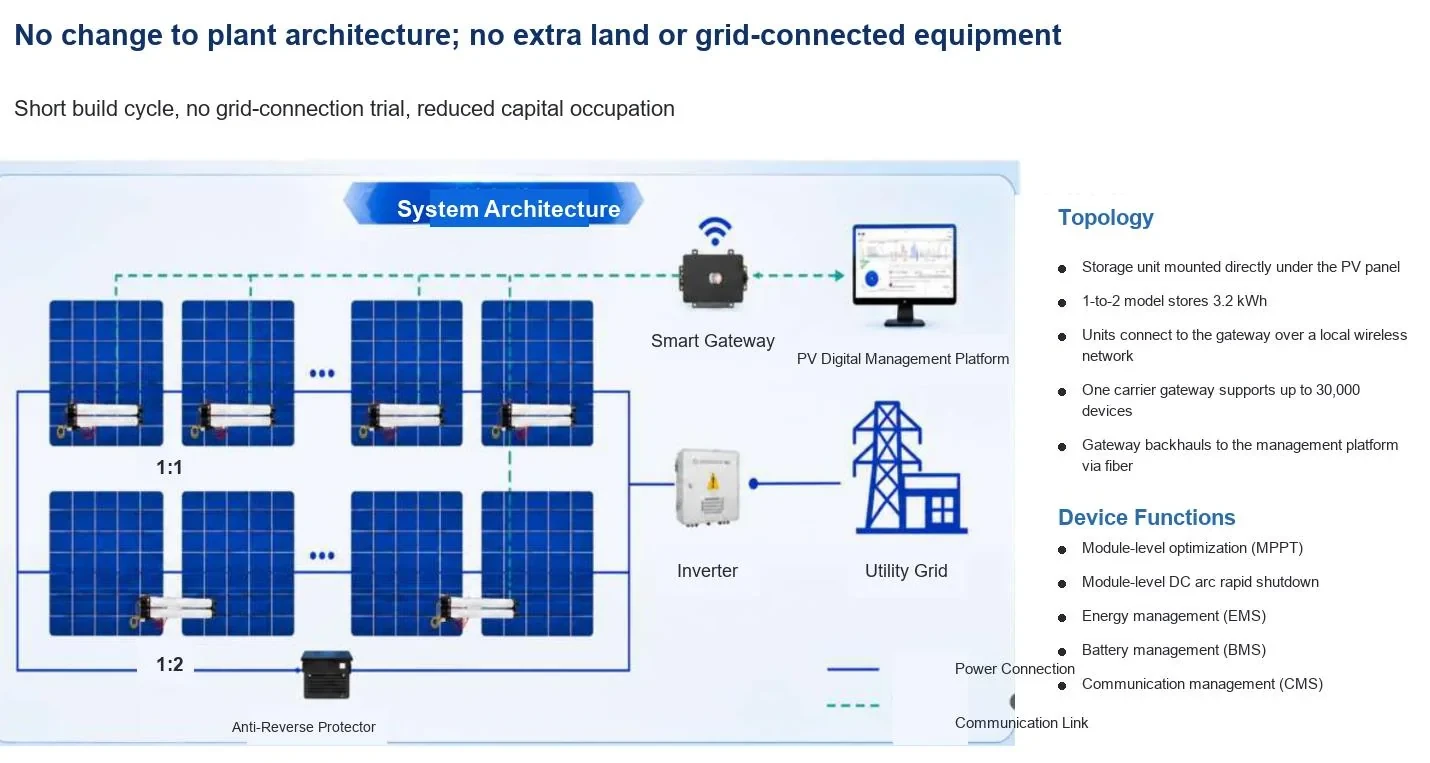
With storage on the DC side, surplus charges directly from the bus and discharges back onto it, so the round trip involves a single DC-to-DC stage. Only the eventual export passes through the plant's existing inverter. Two stages instead of four, no additional thermal load, and a shorter electrical chain with less line loss.
Published efficiency difference
Measured and modeled comparisons put DC-side micro-storage roughly ten points higher on charge and discharge efficiency than the AC side: about eighty percent round trip for a conventional large system versus ninety-two percent or better for board-level DC storage. Over a decade of daily cycling, ten points is a large quantity of energy and a correspondingly large quantity of money.
What stays the same
The inverter, the cabling and the grid connection are unchanged. That is what makes DC coupling attractive on brownfield sites: no new grid study, no protection re-coordination, no change to the plant's interconnection status. The retrofit inserts itself downstream of equipment that already has approvals.
What to measure before committing
Collect the plant's string configuration, module electrical characteristics, existing inverter model and DC input window, then compare them against the product's rated input range and maximum current. Also record connector types and their age. This survey takes a day and determines whether a DC-side retrofit is straightforward or needs engineering work.
A note on string insertion
Inserting a device into an existing string changes its electrical behaviour slightly, and the total string voltage must still sit inside the inverter's operating window across the full temperature range. That is a calculation, not an assumption. Where temperature extremes are wide, check both the cold open-circuit case and the hot operating case before approving the design.
When a hybrid makes sense
Hybrid designs combining DC and AC storage exist, and occasionally they are the right answer: a site with both a DC-native load and a large AC load may benefit from storage on each side. The trade is additional conversion, additional equipment and a longer bill of materials. Decide on the site's load mix rather than on architectural preference, and record the reasoning for the next project on the same portfolio.
Where it does not fit
DC coupling assumes the plant's DC architecture can accept series insertion at the module or string level, and that the modules and connectors are compatible. On some older arrays with unusual string configurations or degraded connectors, that check is a genuine engineering task rather than a formality, and it should happen before any hardware is ordered.
Want this analyzed for your plant?
Send your array data and we will return a technical view within one business day.
Literature search entries on How It Works - Working Principle
The entries below open literature search results rather than single papers, so the reading list can be filtered by date, citation count and full-text availability at the source. 24 queries across five indexes, grouped by source.
Google Scholar1
Semantic Scholar1
Baidu Scholar1
IEEE Xplore1
ScienceDirect1
OpenAlex19
- DC-coupled solar battery charge controller
- module integrated converter photovoltaic
- wireless sensor network PV plant
- local energy management strategy PV storage
- MPPT optimizer battery integrated system
- DC bus voltage control PV battery
- bidirectional DC-DC converter photovoltaic
- two-stage MPPT battery charger
- standalone PV battery system design
- photovoltaic battery charge control algorithm
- DC coupled storage control strategy
- wireless monitoring solar panel
- MPPT algorithm with storage
- PV battery hybrid system operation
- power flow management PV storage
- distributed MPPT per module
- energy storage DC coupled topology
- PV battery converter microgrid
- module-level power electronics storage
Take the Numbers With You
The brochure covers the storage rod, the five safety layers, the gateway and the cloud platform. Download it, or send us your site conditions for a proposal within one business day.