A hanging storage rod is a sealed enclosure carrying cells, electronics and a radio. Understanding its anatomy explains most of the product's behaviour.
Key takeaways
A rod, not a cabinet
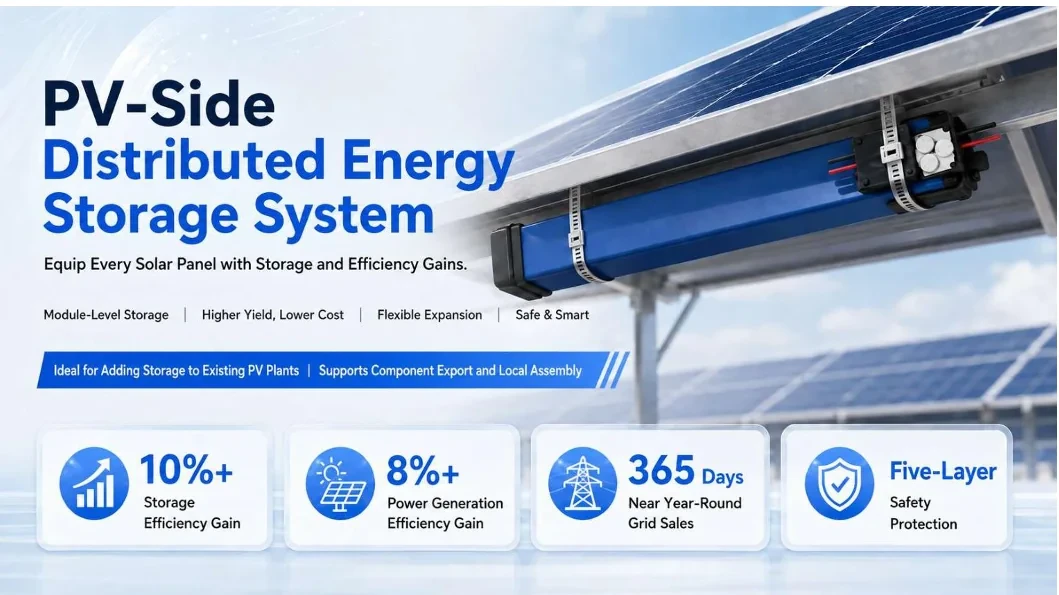
The unit is a slim enclosure roughly the length of a module frame, clamped to the mounting rail beneath the panels. Inside are lithium iron phosphate cells, a battery management board, a DC-to-DC conversion stage, a maximum power point tracker, a shutdown device and a wireless radio. Externally it presents a couple of DC connectors and, in most mounting configurations, nothing else that a passer-by would notice.
Working on the DC side
Because the rod connects between the module and the string, all of its charge and discharge activity happens at low DC voltage. It never converts to alternating current on its own. The central inverter remains the point of grid interface, and the rod simply changes what reaches it: steadier current, fewer mismatch losses and, when discharging, additional energy that would otherwise have been curtailed.
Short cabling, short losses
Energy stored next to the module travels only a few metres before it is used or exported. Long DC or AC runs from a distant container are removed from the round trip. The same proximity reduces the loop area for circulating currents and keeps series resistance low, which is why distributed storage can show better round-trip behaviour than an equivalent central system on the same site.
What it does not need
There is no cabin, no foundation, no liquid cooling loop, no auxiliary air conditioner and no separate fire-suppression skid. Protection is rated for outdoor exposure, and cooling is passive through the enclosure surface. Fewer subsystems means fewer failure modes and a materially shorter commissioning checklist at the plant.
What to expect from a swap programme
Distributed hardware is maintained by replacement rather than repair. A workable programme keeps a small spares pool on site, records the serial number, firmware version and reason for every swap, and returns failed units for bench investigation. Over a year, the swap record becomes the most useful reliability dataset the project owns, because it links field conditions to actual failures.
Sizing the enclosure to the task
Every design choice here is a compromise between capacity per node and heat rejection area. A larger enclosure holds more energy but needs more airflow beneath the module. The practical result is a slim rod-sized unit with a few kilowatt-hours inside, sized so that passive cooling remains sufficient at the top of the specified ambient range.
Materials and finish
Field-mounted hardware lives with ultraviolet exposure, thermal cycling and occasional abrasion. Enclosure material, coating specification and seal type all influence how the unit looks and behaves after five years. Those details rarely appear on a summary data sheet, but they are visible in a site visit: compare an installation that has run through several summers with a new unit and judge the finish rather than the brochure.
Field expectations
Realistic expectations matter more than specifications. Treat each rod as a small, individually addressable asset with its own health data. Expect to swap units occasionally rather than repair them on the rail, expect wireless coverage to be shaped by row geometry, and expect the array's thermal environment to be the design constraint in the harshest sites.
Want this analyzed for your plant?
Send your array data and we will return a technical view within one business day.
Literature search entries on Technical Specifications (Full Datasheet)
The entries below open literature search results rather than single papers, so the reading list can be filtered by date, citation count and full-text availability at the source. 24 queries across five indexes, grouped by source.
Google Scholar1
Semantic Scholar1
Baidu Scholar1
IEEE Xplore1
ScienceDirect1
OpenAlex19
- IEC 62109 safety standard photovoltaic inverter
- DC optimizer specification PV module
- IP65 enclosure photovoltaic electronics
- battery cycle life LFP 6000
- MC4 connector photovoltaic system standard
- photovoltaic connector standards
- battery temperature range specifications
- converter efficiency measurement method
- photovoltaic system EMC standards
- inverter power rating testing
- IP65 rating solar inverter
- IEC 62109 photovoltaic inverter
- UL 1741 inverter interconnection
- lithium battery cycle life testing
- MC4 connector compatibility
- photovoltaic DC cable standard
- inverter restart time standard
- operating temperature range solar electronics
- CE certification PV equipment
Take the Numbers With You
The brochure covers the storage rod, the five safety layers, the gateway and the cloud platform. Download it, or send us your site conditions for a proposal within one business day.