Protocol Design for Large Terminal Counts
Thousands of small devices reporting frequently need a protocol written for density, not for throughput. Compact reporting is what makes it work.
Key takeaways
- A plant with a few hundred inverters can afford chatty telemetry.
- A general-purpose wireless standard carries overhead designed for interoperability rather than for tens of thousands of tiny devices.
- Ask how many units one gateway has carried in production, what the measured reporting latency was at maximum count, how commands are confirmed and retried, and how the protocol behaves wh...
Density changes the requirements
A plant with a few hundred inverters can afford chatty telemetry. A plant with tens of thousands of storage rods cannot. At that scale, every unnecessary byte multiplies, airtime becomes the scarce resource, and a protocol designed for a handful of large devices will saturate before it reaches a quarter of the fleet.
Compact by necessity
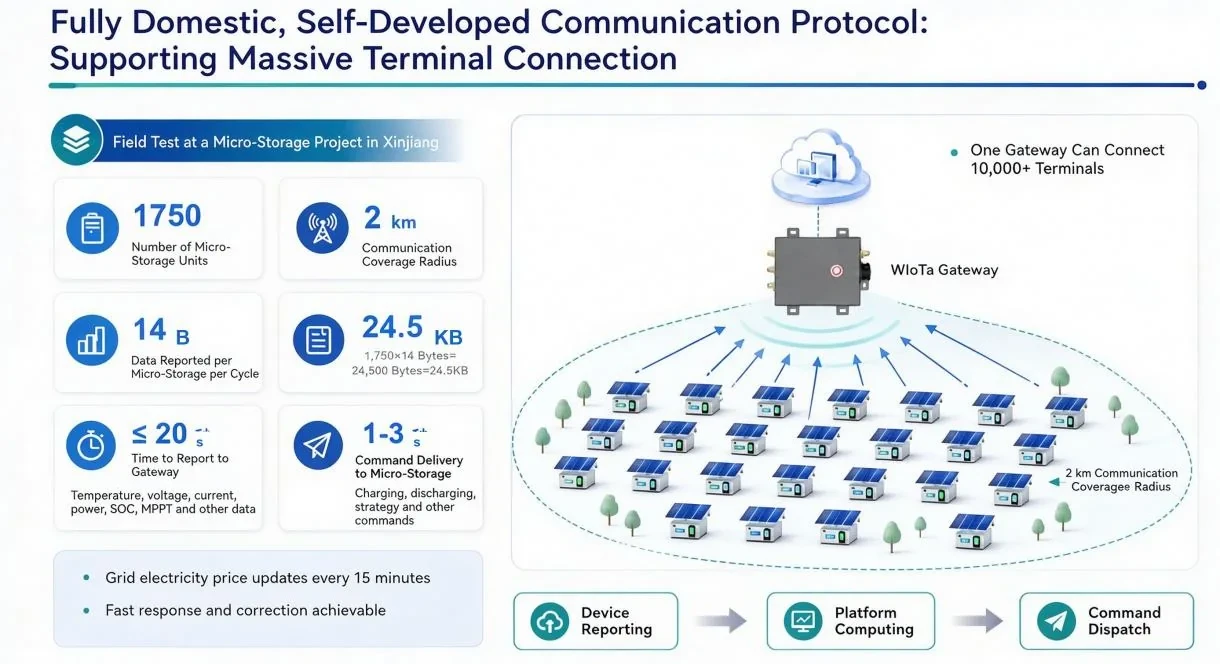
Designing for density means sending what changed and only what changed. Reports carry a small set of parameters, at intervals measured in tens of seconds, in payloads measured in single-digit bytes. Aggregated fleets have demonstrated a full telemetry cycle for well over a thousand units inside a single modest report volume, which is what allows one gateway to serve a large area.
Latency under load
Two latency numbers matter operationally. Reporting latency determines how quickly the platform notices a condition; command latency determines how quickly the plant can respond to a price or dispatch change. Field values in the range of twenty seconds for reporting and one to three seconds for commands are workable for retail tariff windows and weather-driven corrections.
Command paths and confirmation
Every command should return a verified state, not just an acknowledgement. If a dispatch message is accepted but the device did not change mode, the platform must know. That closed loop, plus retention of the last commanded strategy, is what protects a fleet during partial connectivity and what makes automated dispatch defensible in an audit.
Why the protocol is proprietary
A general-purpose wireless standard carries overhead designed for interoperability rather than for tens of thousands of tiny devices. A purpose-built protocol can strip that overhead, define compact reports and prioritise commands. The trade is that the ecosystem is narrower: integration with third-party platforms depends on the vendor exposing an interface rather than on a standard being available.
Data volume planning
Calculate expected traffic from the fleet size, report interval and payload size, then compare it with the available link. A compact protocol keeps this arithmetic comfortable, but the calculation should still be done for the largest site planned, with headroom for firmware distribution, because updates are considerably heavier than routine telemetry.
Interoperability as a commercial question
Owners dislike being tied to a single vendor's software even when they accept a single hardware vendor. Ask whether device events can be exported, in what format, and whether a standards-based interface is on the roadmap. An export path is often enough: it lets the operator retain a historical copy and integrate alarms with existing systems without demanding full protocol openness on day one.
Questions for a vendor
Ask how many units one gateway has carried in production, what the measured reporting latency was at maximum count, how commands are confirmed and retried, and how the protocol behaves when two gateways overlap. A protocol claim without production counts is a design intention rather than an engineering result.
Want this analyzed for your plant?
Send your array data and we will return a technical view within one business day.
Literature search entries on System Architecture & Wireless Mesh Networking
The entries below open literature search results rather than single papers, so the reading list can be filtered by date, citation count and full-text availability at the source. 24 queries across five indexes, grouped by source.
Google Scholar1
Semantic Scholar1
Baidu Scholar1
IEEE Xplore1
ScienceDirect1
OpenAlex19
- wireless mesh network photovoltaic monitoring
- large scale IoT wireless energy management
- self-organizing mesh protocol distributed energy
- module-level communication PV plant
- second-level response PV storage control
- wireless communication protocols microgrid
- network topology large PV plant
- IoT data acquisition solar farm
- self-healing mesh energy network
- Zigbee based photovoltaic monitoring
- LoRa wireless monitoring PV
- mesh network distributed energy resources
- sensor network large scale solar
- daisy-chain communication PV module
- wireless battery management system
- remote monitoring solar microgrid
- bluetooth mesh PV plant
- cloud based data acquisition photovoltaic
- network reliability PV communication
Take the Numbers With You
The brochure covers the storage rod, the five safety layers, the gateway and the cloud platform. Download it, or send us your site conditions for a proposal within one business day.