One-to-Two Wiring and Modular Capacity
A single rod can serve one or two modules. That small decision shapes labour, capacity granularity and how a retrofit phases over time.
Key takeaways
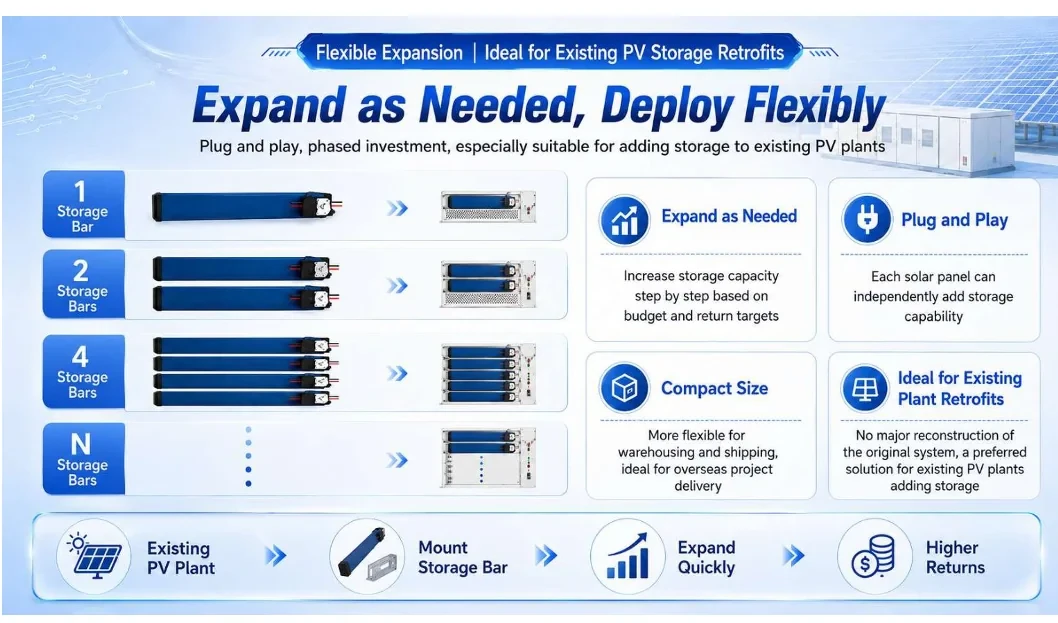
The wiring choice
A rod supports a one-to-one or one-to-two connection pattern, sharing its electronics and battery across one or two modules. One-to-two reduces the number of enclosures per row, which lowers hardware count and installation time. One-to-one increases per-module granularity, which can be preferable where shading patterns are highly irregular or where module-level reporting is a stated requirement.
Capacity granularity
Each rod stores a few kilowatt-hours. That granularity is the point: capacity grows in small increments, so a buyer can add storage where losses are highest and skip rows that are already performing well. On a large array, this is a far more precise instrument than a single block sized to a plant-wide average.
Effect on labour
Fewer enclosures mean fewer clamps, fewer connectors and fewer addressing steps. Shared electronics also reduce the number of devices that must be registered and later maintained. The trade-off appears in diagnostics: with one-to-two wiring, a fault report covers two modules, so interpretation needs a slightly less granular map of the row.
Phasing with mixed patterns
Nothing prevents a phased project from starting one-to-one on critical rows and one-to-two on the remainder. Because each rod is independently addressed, the two patterns coexist in the same array and report into the same platform, which lets a pilot use dense instrumentation and a later expansion use more economical coverage.
Reporting granularity by pattern
The one-to-two pattern reports per enclosure, which covers two modules. If the operating team needs to identify an individual module's behaviour, the reporting map must be explicit about that grouping, otherwise a fault report will send a technician to the right enclosure with the wrong expectation about which module is involved.
Spares and inventory planning
Fewer enclosures mean fewer spares to stock, which matters on sites where lead times are long. Base the spares quantity on the number of enclosures rather than the number of modules, and keep at least one unit per array section so a swap never waits for a shipment. That rule is simple and it prevents most avoidable downtime.
Documenting the row map
Whichever wiring pattern is used, produce a row map showing which device serves which module, with addresses and serial numbers. The map is the difference between a maintenance visit that takes twenty minutes and one that takes half a day. Update it whenever a unit is swapped, and keep the current version where the site team can reach it without contacting the supplier.
How to decide
Choose based on shading uniformity, reporting requirements and labour assumptions. For uniform open rows, the two-module pattern is usually the better economic choice. For dense, obstructed or experimentally interesting arrays, the one-module pattern buys information and per-panel control. Publish the decision with the row map so the site's maintenance team knows what each enclosure serves.
Want this analyzed for your plant?
Send your array data and we will return a technical view within one business day.
Literature search entries on How It Works - Working Principle
The entries below open literature search results rather than single papers, so the reading list can be filtered by date, citation count and full-text availability at the source. 24 queries across five indexes, grouped by source.
Google Scholar1
Semantic Scholar1
Baidu Scholar1
IEEE Xplore1
ScienceDirect1
OpenAlex19
- DC-coupled solar battery charge controller
- module integrated converter photovoltaic
- wireless sensor network PV plant
- local energy management strategy PV storage
- MPPT optimizer battery integrated system
- DC bus voltage control PV battery
- bidirectional DC-DC converter photovoltaic
- two-stage MPPT battery charger
- standalone PV battery system design
- photovoltaic battery charge control algorithm
- DC coupled storage control strategy
- wireless monitoring solar panel
- MPPT algorithm with storage
- PV battery hybrid system operation
- power flow management PV storage
- distributed MPPT per module
- energy storage DC coupled topology
- PV battery converter microgrid
- module-level power electronics storage
Take the Numbers With You
The brochure covers the storage rod, the five safety layers, the gateway and the cloud platform. Download it, or send us your site conditions for a proposal within one business day.