Converting a Module Row into a Dispatchable Asset
The end state of a retrofit is a row that can be told when to charge and when to discharge, with each panel reporting its own behaviour.
Key takeaways
- A conventional module row is passive: it produces whatever the weather allows and hands it to the inverter.
- Once a row is dispatchable, the first changes cost nothing: shift discharge later into the evening peak, hold a reserve for outages rather than discharging fully, and align charging with...
- Track three things after commissioning: delivered energy per treated row, discharge energy actually used, and availability of the dispatch path.
From passive to controllable
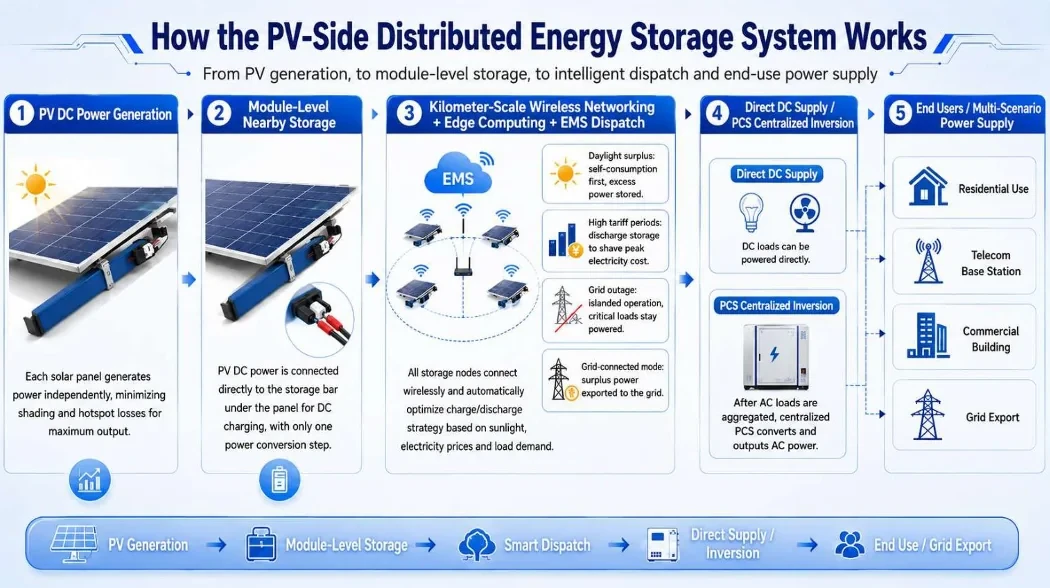
A conventional module row is passive: it produces whatever the weather allows and hands it to the inverter. After a retrofit, the same row becomes a controllable unit. Each rod decides locally whether to store or pass energy, and the site-level controller can shift aggregate behaviour across the whole array. Nothing about the hardware's appearance changes; its role does.
The control loop
The loop is short by design. The platform publishes a strategy, the gateway holds it locally, and rods execute it against their own measurements. State of charge, temperature and power return through the same path. Because decisions are local, a row reacts to changing conditions within seconds rather than waiting for a distant control centre.
What becomes possible
Once a row is dispatchable, several commercial options open. Midday curtailment can be captured and released later; commercial sites can flatten their import peaks; telecom loads can be served from solar through the evening; and output can be smoothed to reduce the variability that penalties target. Each option is a strategy change on existing hardware rather than a new purchase.
Observability is the precondition
Dispatch only works if the platform can see what is happening. Per-module reporting, per-rod state and fault history convert a plant from a monthly production report into a real-time operating picture. That granularity is also what allows precise fault location instead of sending a crew to hunt through a megawatt block.
Strategy changes worth trying first
Once a row is dispatchable, the first changes cost nothing: shift discharge later into the evening peak, hold a reserve for outages rather than discharging fully, and align charging with the midday surplus rather than with a fixed schedule. These three adjustments typically deliver most of the available value before any additional hardware is considered.
Scaling rules once dispatch works
Expansion should follow demonstrated operation, not ambition. A practical rule is to extend to the next section only when the current one meets its delivery target and its dispatch path has stayed available for a full quarter. That discipline keeps capital aligned with performance and makes each increment an easy decision for the owner.
Building a strategy library
Different sites want different behaviour, and there is no reason to re-derive each one. Keep a small library of named strategies: midday capture for curtailed plants, evening shift for commercial rooftops, reserve-first for weak-grid sites, and outage ride-through for telecom. Evidence from each becomes reusable across a portfolio, which is where a distributed fleet starts to feel like a system rather than a collection of devices.
Measuring success
Track three things after commissioning: delivered energy per treated row, discharge energy actually used, and availability of the dispatch path. If delivered energy rose and the dispatch path stayed available, the row has genuinely become an asset. If only one moved, the retrofit has a control or commercial problem to resolve before expansion.
Want this analyzed for your plant?
Send your array data and we will return a technical view within one business day.
Literature search entries on How It Works - Working Principle
The entries below open literature search results rather than single papers, so the reading list can be filtered by date, citation count and full-text availability at the source. 24 queries across five indexes, grouped by source.
Google Scholar1
Semantic Scholar1
Baidu Scholar1
IEEE Xplore1
ScienceDirect1
OpenAlex19
- DC-coupled solar battery charge controller
- module integrated converter photovoltaic
- wireless sensor network PV plant
- local energy management strategy PV storage
- MPPT optimizer battery integrated system
- DC bus voltage control PV battery
- bidirectional DC-DC converter photovoltaic
- two-stage MPPT battery charger
- standalone PV battery system design
- photovoltaic battery charge control algorithm
- DC coupled storage control strategy
- wireless monitoring solar panel
- MPPT algorithm with storage
- PV battery hybrid system operation
- power flow management PV storage
- distributed MPPT per module
- energy storage DC coupled topology
- PV battery converter microgrid
- module-level power electronics storage
Take the Numbers With You
The brochure covers the storage rod, the five safety layers, the gateway and the cloud platform. Download it, or send us your site conditions for a proposal within one business day.