Phased Purchasing as Financial Optionality
Buying storage in stages is not just a budget tactic. It converts an uncertain model into a sequence of measured decisions.
Key takeaways
- Storage business cases rest on assumptions about curtailment, tariffs and yield gain, and those assumptions are uncertain for the same reason the project is interesting.
- Phasing has to be explained, or it reads as indecision.
- Define the gate criteria before the pilot starts: what measured result justifies stage two, and what result stops the program.
The uncertainty problem
Storage business cases rest on assumptions about curtailment, tariffs and yield gain, and those assumptions are uncertain for the same reason the project is interesting. A single large procurement forces the owner to commit to one set of assumptions. A phased approach lets each stage be justified by the measured performance of the previous one.
Starting small, learning fast
A pilot of a few dozen units on representative rows produces real numbers within months: delivered energy, discharge utilization, availability and swap rate. Those numbers then size the next stage. The pilot is not a demonstration; it is the data collection that a lender or internal committee will want regardless of which vendor wins the larger order.
Reversibility as value
Phasing limits downside. If a site's curtailment pattern changes, expansion can pause without stranding a large asset. If policy improves, expansion can accelerate. Because capacity arrives in small increments, a project can be stopped, resumed or redirected at a row boundary rather than at a megawatt commitment.
Financing implications
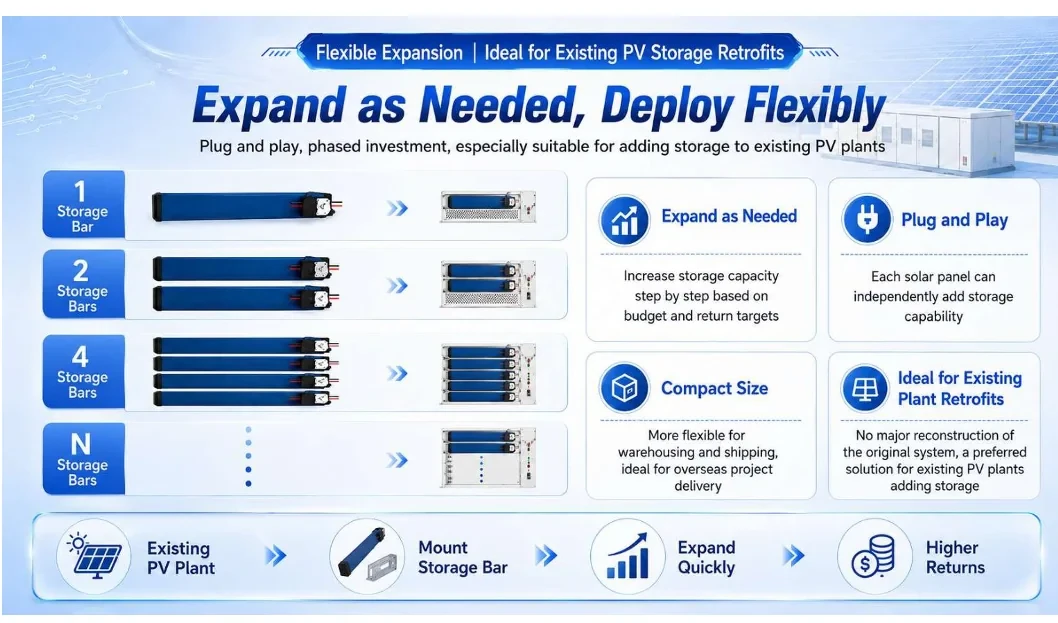
Staged capital is easier to approve from operating budgets and easier to align with annual investment cycles. It also spreads procurement across fiscal years, which matters in organizations where capex approval is the real bottleneck rather than total cost. Those advantages are structural, not accounting tricks.
Communicating phasing to stakeholders
Phasing has to be explained, or it reads as indecision. Present it as a sequence with defined gates: pilot, measured review, expansion, second review. Each gate has a criterion and an owner. Framed that way, a phased plan is a stronger commitment than a single large order, because it states in advance what evidence will justify each step.
Setting the pilot's exit criteria
The pilot should have an end date and a decision. Define what measured result triggers expansion, what result triggers a change of approach, and what result ends the programme. Writing these down before installation prevents the most common failure of pilots, which is continuing indefinitely without a decision while costs accumulate.
Sequencing across fiscal years
Staged procurement maps naturally onto annual budget cycles, but only if the stages are sized to fit the approvals available each year. A plan that needs a single large approval will stall in the year it is submitted; a plan with three moderate stages can proceed while the business case matures. Sizing the phases to the approval process is as important as sizing them to the engineering.
Making phasing deliberate
Define the gate criteria before the pilot starts: what measured result justifies stage two, and what result stops the program. A phasing plan with explicit gates is a credible document. A phasing plan without them is simply an under-funded project waiting to be cancelled.
Want this analyzed for your plant?
Send your array data and we will return a technical view within one business day.
Literature search entries on Pilot Roadmap, Commercial Entry & Buyer Questions
The entries below open literature search results rather than single papers, so the reading list can be filtered by date, citation count and full-text availability at the source. 24 queries across five indexes, grouped by source.
Google Scholar1
Semantic Scholar1
Baidu Scholar1
IEEE Xplore1
ScienceDirect1
OpenAlex19
- energy storage pilot project adoption barrier
- technology acceptance renewable energy storage
- energy storage certification standards UL CE
- PV storage project payback period
- maintenance strategy distributed battery system
- storage pilot project safety regulations
- energy storage insurance risk
- customer satisfaction solar storage
- lifecycle cost storage system
- warranty strategy battery energy storage
- market acceptance residential battery
- regulatory barriers energy storage
- pilot project photovoltaic storage
- early adoption solar battery
- installation cost PV storage
- operation and maintenance solar storage
- incentives for behind the meter storage
- reliability assessment distributed storage
- software platform solar storage integration
Take the Numbers With You
The brochure covers the storage rod, the five safety layers, the gateway and the cloud platform. Download it, or send us your site conditions for a proposal within one business day.