Why Ten Points of Efficiency Compound Over a Decade
A percentage point of round-trip efficiency looks small in a data sheet. Multiplied by daily cycling and a ten-year life, it stops looking small.
Key takeaways
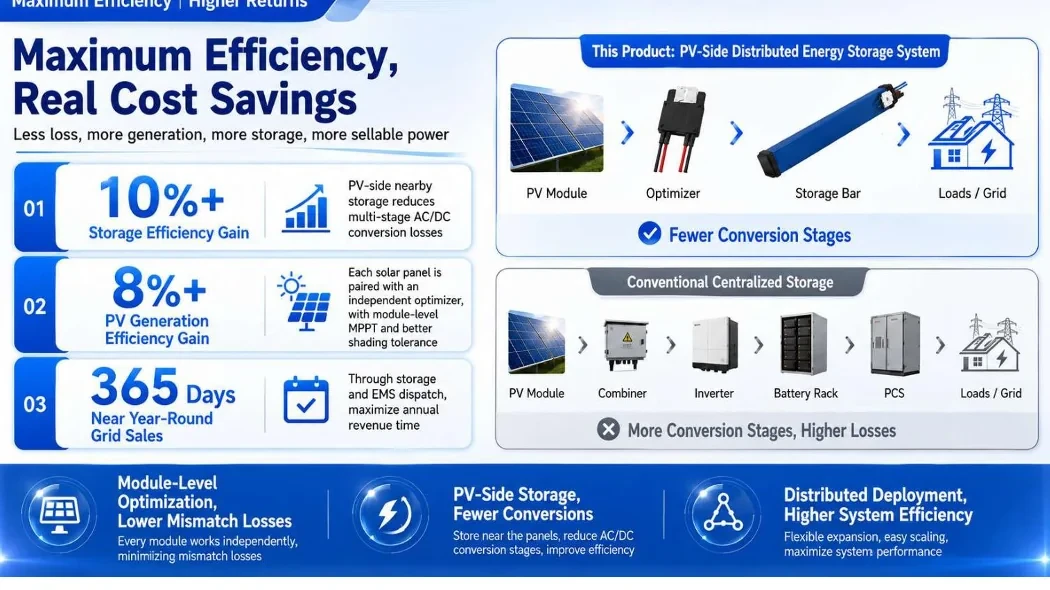
Turning efficiency into energy
Ten percentage points of round-trip efficiency means that for every hundred kilowatt-hours routed through storage, ten more arrive at the meter. On a plant discharging daily, that extra energy accumulates every day, in every season, without any additional capital. Efficiency is therefore not a technical nicety; it is a renewable revenue stream embedded in the hardware.
The cycle-life multiplier
Quality cells in this application are specified for around six thousand cycles, which corresponds to roughly ten years of daily operation. Multiply a daily efficiency advantage across that number of cycles and the gap between two architectures becomes measurable in tonnes of carbon and in project-level cash. The comparison should always be made on lifetime throughput rather than on first-year output.
Efficiency on the DC side is not free
DC-side architectures accept constraints in exchange for the efficiency gain. They operate at low voltage, which limits per-unit power, and they place electronics in a harsher thermal environment beneath the modules. A serious comparison states both sides: the conversion advantage and the environmental demand that comes with mounting hardware in the field.
Interactions with other gains
Conversion efficiency multiplies with optimization gain. Independent per-panel tracking recovers yield that mismatch was consuming, and the improved conversion chain then preserves more of what is recovered. Buying the two as one integrated enclosure means the compounding effect is not diluted by an extra stage somewhere else in the system.
Building the case for a committee
Efficiency gains are technically satisfying and financially abstract. Convert them into the language of an investment committee: additional megawatt-hours per year, additional revenue at the applicable tariff, and lifetime throughput over the asset life. Combine the conversion gain with the optimization gain into one figure, because that is the number the decision actually turns on.
Sensitivity worth running
Run three sensitivities: efficiency advantage at half the expected value, cell degradation at the optimistic end of the range, and tariff or dispatch value twenty percent lower than assumed. If the project still clears its hurdle rate under all three, the case is robust. If it only works at the central assumption, the honest recommendation is a pilot rather than a rollout.
Assumptions behind cycling estimates
Lifetime throughput depends on how many cycles occur each year, and that number is a site property rather than a product one. A plant with heavy midday curtailment may cycle daily through most of the year; a site with occasional spikes may cycle far less often. Anchor the compounding calculation on measured charge and discharge events from comparable sites instead of assuming one cycle per day everywhere.
What to model
Model three scenarios: efficiency alone, optimization alone, and both together. Most buyers are surprised by how much of the total value comes from the interaction rather than from either feature. Presenting that interaction clearly is the fastest way to move a technical discussion toward a commercial decision.
Want this analyzed for your plant?
Send your array data and we will return a technical view within one business day.
Literature search entries on Efficiency, Cost & Core Advantages
The entries below open literature search results rather than single papers, so the reading list can be filtered by date, citation count and full-text availability at the source. 24 queries across five indexes, grouped by source.
Google Scholar1
Semantic Scholar1
Baidu Scholar1
IEEE Xplore1
ScienceDirect1
OpenAlex19
- round-trip efficiency DC coupled vs AC coupled storage
- comparison AC side storage DC side storage efficiency
- levelized cost of energy solar PV storage
- photovoltaic mismatch loss module-level MPPT
- energy storage thermal management power consumption
- storage round-trip efficiency optimization
- PV battery system cost reduction
- capacity degradation PV storage
- photovoltaic storage payback analysis
- mismatch losses mitigation PV
- energy storage round trip AC DC
- PV self-consumption rate battery
- economic benefits distributed storage
- heat losses power electronics PV
- availability factor solar storage
- lcoe comparison AC DC coupled
- photovoltaic battery efficiency measurement
- internal rate of return solar storage
- operating cost PV battery system
Take the Numbers With You
The brochure covers the storage rod, the five safety layers, the gateway and the cloud platform. Download it, or send us your site conditions for a proposal within one business day.