Pricing Logic: Never Quote Cell Cost Alone
Comparing a distributed retrofit with a container on cost per kilowatt-hour ignores everything the container needs around it.
Key takeaways
- Storage is routinely compared on cost per kilowatt-hour of capacity, and that number favors large centralized systems because they buy cells at scale.
- State the benchmark in the proposal itself: delivered diesel cost, alternative storage plus its land and civil scope, or the value of the demand reduction.
- Show total installed cost for both options, the timeline for each, and the exposure if the project must be paused.
The misleading unit price
Storage is routinely compared on cost per kilowatt-hour of capacity, and that number favors large centralized systems because they buy cells at scale. The comparison becomes meaningful only when the surrounding scope is included: civil works, foundations, high-voltage connection, cooling, fire engineering, land and the cost of the generation days lost during construction.
Choose the right benchmark
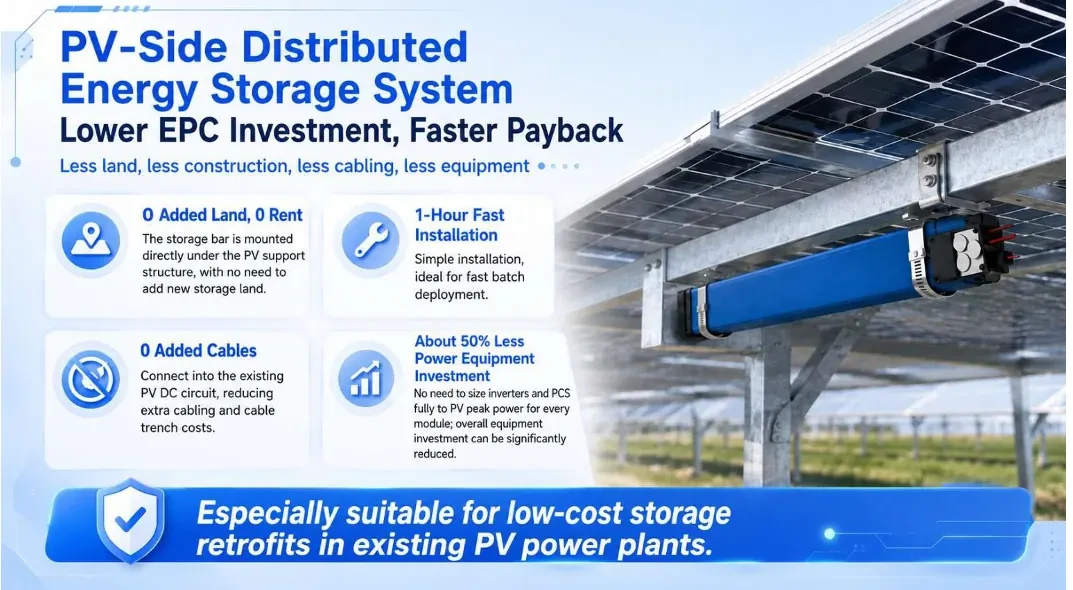
For an off-grid site, the correct benchmark is the delivered cost of diesel energy. For a retrofit on a constrained plant, it is the cost of the alternative storage plus its land and civil scope. For a commercial rooftop, it is the value of the demand reduction. In all three cases, the per-kilowatt-hour cell price is the least informative figure available.
What the retrofit includes
A panel-mounted system bundles optimization, storage, shutdown and networking in one enclosure, installed without a cabin or a foundation. That integration removes several separate procurements from the bill, and it removes the coordination cost that shows up later as delays. Total installed cost, not hardware cost, is what the owner's finance team will evaluate.
The optionality premium
Distributed capacity can be bought in phases, so a buyer is also paying for the right not to commit. That option has genuine value when tariff rules, curtailment patterns or grid conditions may change. Centralized procurement usually forfeits it, and that lost flexibility rarely appears anywhere in a comparison table.
Building the benchmark into the bid
State the benchmark in the proposal itself: delivered diesel cost, alternative storage plus its land and civil scope, or the value of the demand reduction. Naming the benchmark invites a challenge to the assumptions, which is a far better conversation than a dispute about a unit price that does not determine the outcome of the project.
What optionality is worth
The right to stop, pause or expand has value that rarely appears in a comparison table. Approximate it by asking what the project would lose if the assumptions behind it were wrong and the buyer were committed to full capacity. Where that exposure is large, phasing is worth a premium, and the proposal should say so explicitly.
Presenting lifetime cost of ownership
Gather hardware, installation, land or civil scope, thermal auxiliary consumption, maintenance and replacement over the asset's life onto one page. For a distributed retrofit, add the value of phasing and the avoided interruption. The resulting number is less precise than a hardware price, but it is the figure that determines whether the project is funded, so it should be presented with its assumptions rather than avoided for being approximate.
How to present a proposal
Show total installed cost for both options, the timeline for each, and the exposure if the project must be paused. Then state the benchmark explicitly. A proposal that names its benchmark invites a substantive discussion; a proposal that quotes only a unit price invites an argument about a number that does not decide the outcome.
Want this analyzed for your plant?
Send your array data and we will return a technical view within one business day.
Literature search entries on Efficiency, Cost & Core Advantages
The entries below open literature search results rather than single papers, so the reading list can be filtered by date, citation count and full-text availability at the source. 24 queries across five indexes, grouped by source.
Google Scholar1
Semantic Scholar1
Baidu Scholar1
IEEE Xplore1
ScienceDirect1
OpenAlex19
- round-trip efficiency DC coupled vs AC coupled storage
- comparison AC side storage DC side storage efficiency
- levelized cost of energy solar PV storage
- photovoltaic mismatch loss module-level MPPT
- energy storage thermal management power consumption
- storage round-trip efficiency optimization
- PV battery system cost reduction
- capacity degradation PV storage
- photovoltaic storage payback analysis
- mismatch losses mitigation PV
- energy storage round trip AC DC
- PV self-consumption rate battery
- economic benefits distributed storage
- heat losses power electronics PV
- availability factor solar storage
- lcoe comparison AC DC coupled
- photovoltaic battery efficiency measurement
- internal rate of return solar storage
- operating cost PV battery system
Take the Numbers With You
The brochure covers the storage rod, the five safety layers, the gateway and the cloud platform. Download it, or send us your site conditions for a proposal within one business day.