Second-Level Response and Forecast Confidence
Assessment regimes reward plants whose output matches what they promised. Fast, granular response is how variability stops becoming a penalty.
Key takeaways
- Grid and market arrangements increasingly judge plants on delivered output against declared output.
- A confidence figure becomes useful when it is written into a performance commitment.
- Ask for the measurement basis behind any confidence figure: reporting interval, sensor placement, data completeness over a full year and treatment of offline devices.
What assessment rewards
Grid and market arrangements increasingly judge plants on delivered output against declared output. Clouds, soiling and curtailment events are what push a plant outside tolerance, and the penalty falls on the plant, not on the weather. The measurable requirement is therefore responsiveness: how quickly can the system correct after a change?
Response in seconds
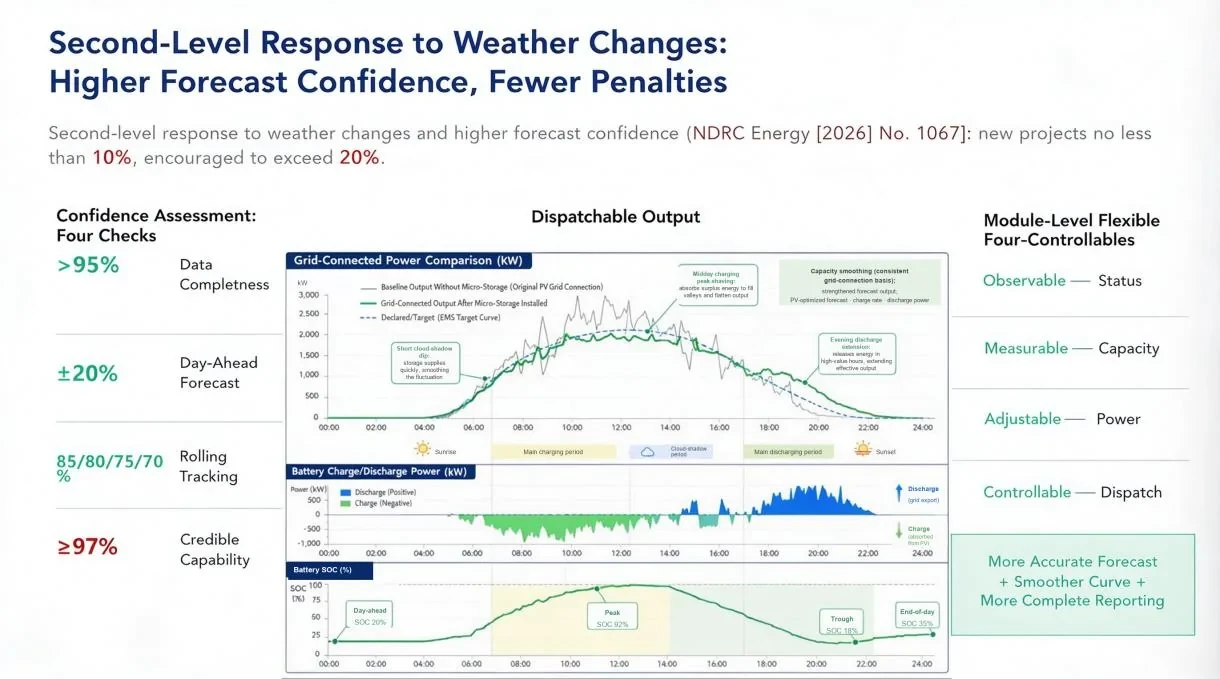
Distributed storage can adjust power within a row in seconds because each enclosure makes its own decisions and the gateway holds local strategy. That speed lets the plant respond to passing cloud, a dispatch instruction or a tariff step without waiting for a central controller to compute and distribute a new setpoint.
Confidence numbers that matter
Reference material for this application reports data completeness above ninety-five percent, day-ahead forecast deviation of roughly twenty percent, rolling tracking accuracy in the eighty to high-seventy percent bands, and capability credibility of ninety-seven percent or better. Each figure describes a different link in the chain from measurement to declaration, and each can be improved with better instrumentation.
Four observability properties
The useful shorthand is whether the system is observable, measurable, adjustable and controllable. Status must be visible, capacity must be quantified, power must be alterable and dispatch must be executable. A fleet that satisfies all four can be represented in a scheduling system with confidence; one that satisfies two cannot.
Turning confidence figures into obligations
A confidence figure becomes useful when it is written into a performance commitment. Specify the reporting interval, the completeness threshold and the correction window, then define what happens if the plant misses them. That converts a marketing claim into an operational requirement with consequences, which is what an assessment regime or an asset manager actually needs.
Instrumentation quality first
No forecasting method outperforms its inputs. Sensor placement, calibration status and data completeness set the ceiling on achievable accuracy, so instrumentation deserves as much attention as algorithm selection. Before accepting any confidence figure, ask how many sensors exist, where they are placed and what proportion of intervals reported complete data last year.
Roles and responsibilities
Fast response only matters if someone can act on it. Assign clear responsibilities for watching anomalies, approving remote commands and escalating to the site team, and record them in the operating procedure. Where a dispatch instruction is generated automatically, define who may override it and under what conditions. Unassigned responsibilities quietly turn a responsive system back into a reporting one.
What to request before believing a number
Ask for the measurement basis behind any confidence figure: reporting interval, sensor placement, data completeness over a full year and treatment of offline devices. Precision claims without methodology are marketing; with methodology, they become engineering evidence a buyer can present to their own regulator.
Want this analyzed for your plant?
Send your array data and we will return a technical view within one business day.
Literature search entries on Efficiency, Cost & Core Advantages
The entries below open literature search results rather than single papers, so the reading list can be filtered by date, citation count and full-text availability at the source. 24 queries across five indexes, grouped by source.
Google Scholar1
Semantic Scholar1
Baidu Scholar1
IEEE Xplore1
ScienceDirect1
OpenAlex19
- round-trip efficiency DC coupled vs AC coupled storage
- comparison AC side storage DC side storage efficiency
- levelized cost of energy solar PV storage
- photovoltaic mismatch loss module-level MPPT
- energy storage thermal management power consumption
- storage round-trip efficiency optimization
- PV battery system cost reduction
- capacity degradation PV storage
- photovoltaic storage payback analysis
- mismatch losses mitigation PV
- energy storage round trip AC DC
- PV self-consumption rate battery
- economic benefits distributed storage
- heat losses power electronics PV
- availability factor solar storage
- lcoe comparison AC DC coupled
- photovoltaic battery efficiency measurement
- internal rate of return solar storage
- operating cost PV battery system
Take the Numbers With You
The brochure covers the storage rod, the five safety layers, the gateway and the cloud platform. Download it, or send us your site conditions for a proposal within one business day.