Operating in Heat, Dust and Sand: Field Notes
Large desert arrays are the hardest environment for under-panel hardware. Heat, abrasive dust and wide temperature swings set the design agenda.
Key takeaways
- If hardware survives a large ground-mount array in sandy, high-temperature conditions, it will survive most commercial sites.
- Desert deployments reward preparation more than specification.
- Ask for continuous run data from a comparable climate, high-temperature operation records, dust exposure results, and the module back-sheet temperature-rise test.
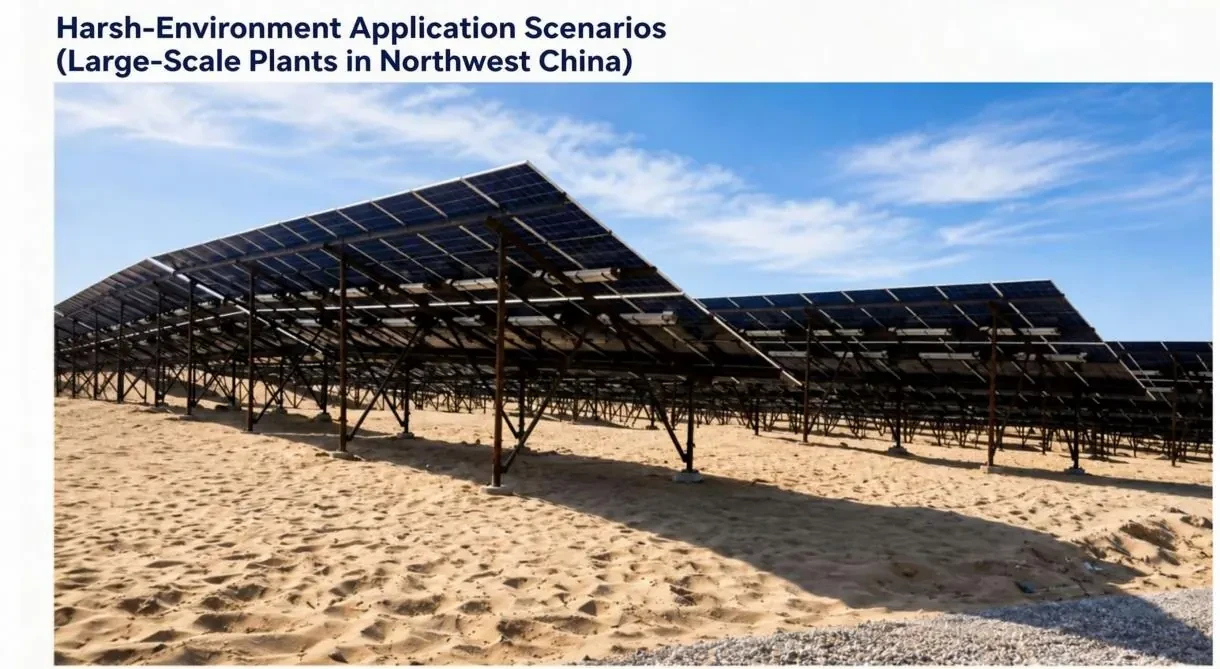
Why the harsh case matters
If hardware survives a large ground-mount array in sandy, high-temperature conditions, it will survive most commercial sites. Designing for the difficult case first is therefore a discipline rather than a marketing choice: a specification that meets a desert plant's requirements is unlikely to be marginal anywhere else.
Heat, in two directions
Ambient temperature in desert arrays can stay high well into the evening, and the module back sheet adds radiant load during the day. Cells and electronics both experience elevated temperatures, which is why operating range, derating behaviour and thermal monitoring are documented so carefully. Passive cooling keeps the design simple, but it makes siting and airflow the critical variables.
Dust and abrasion
Fine sand is abrasive and finds every gap. Enclosures sealed to a suitable ingress protection rating close the obvious path, and cable glands and connector interfaces take the rest of the attention. Because dust also settles on module surfaces and reduces yield, soiling-corrected performance data is essential when presenting gains from a dusty site.
Temperature cycling
Desert sites cycle broadly between day and night, which works on seals, solder joints and connector contacts. Units designed to be replaceable rather than repairable are the practical answer: a failed rod is swapped in a few minutes and returned for bench investigation, rather than becoming a field-repair project in an uncomfortable location.
Preparing hardware for a desert site
Desert deployments reward preparation more than specification. Confirm the ingress protection rating, check that cable glands and connectors are rated for the dust and temperature expected, and plan the mounting so the enclosure is not fully exposed to reflected radiation. Small decisions about orientation and spacing often matter more than a marginally better cell.
Cleaning and access considerations
Dust affects the modules more than the storage, and soiling typically reduces yield before it inconveniences any electronics. That links two maintenance routines: panel cleaning and enclosure inspection. Scheduling them together reduces site visits, and it means a technician who is already at the row can check connector condition and seals at the same time.
Commissioning in extreme heat
Commissioning work in desert conditions is best scheduled early in the day, when ambient temperature is lowest and the array is still cool. Record enclosure temperatures during the first hot week of operation as a baseline, then compare them with the design assumption. Deviations found in that first week can usually be resolved with siting or spacing changes rather than hardware replacement.
Field evidence to request
Ask for continuous run data from a comparable climate, high-temperature operation records, dust exposure results, and the module back-sheet temperature-rise test. A vendor who has run units through a full summer in comparable conditions can answer these with data; a vendor who has not can only answer with intentions.
Want this analyzed for your plant?
Send your array data and we will return a technical view within one business day.
Literature search entries on Efficiency, Cost & Core Advantages
The entries below open literature search results rather than single papers, so the reading list can be filtered by date, citation count and full-text availability at the source. 24 queries across five indexes, grouped by source.
Google Scholar1
Semantic Scholar1
Baidu Scholar1
IEEE Xplore1
ScienceDirect1
OpenAlex19
- round-trip efficiency DC coupled vs AC coupled storage
- comparison AC side storage DC side storage efficiency
- levelized cost of energy solar PV storage
- photovoltaic mismatch loss module-level MPPT
- energy storage thermal management power consumption
- storage round-trip efficiency optimization
- PV battery system cost reduction
- capacity degradation PV storage
- photovoltaic storage payback analysis
- mismatch losses mitigation PV
- energy storage round trip AC DC
- PV self-consumption rate battery
- economic benefits distributed storage
- heat losses power electronics PV
- availability factor solar storage
- lcoe comparison AC DC coupled
- photovoltaic battery efficiency measurement
- internal rate of return solar storage
- operating cost PV battery system
Take the Numbers With You
The brochure covers the storage rod, the five safety layers, the gateway and the cloud platform. Download it, or send us your site conditions for a proposal within one business day.