Sizing a Shared 4G and 5G Base Station
A worked configuration for a typical shared site: array size, storage block, daily generation and how the numbers hold together.
Key takeaways
- A shared fourth and fifth generation site typically draws on the order of a hundred and thirty kilowatt-hours per day, and that load continues around the clock.
- The generation area and the mounting positions should be chosen together.
- Confirm the site's actual load profile over at least a month, verify the usable area and structural capacity, and check local rules on roof-mounted generation at telecom sites.
The load to serve
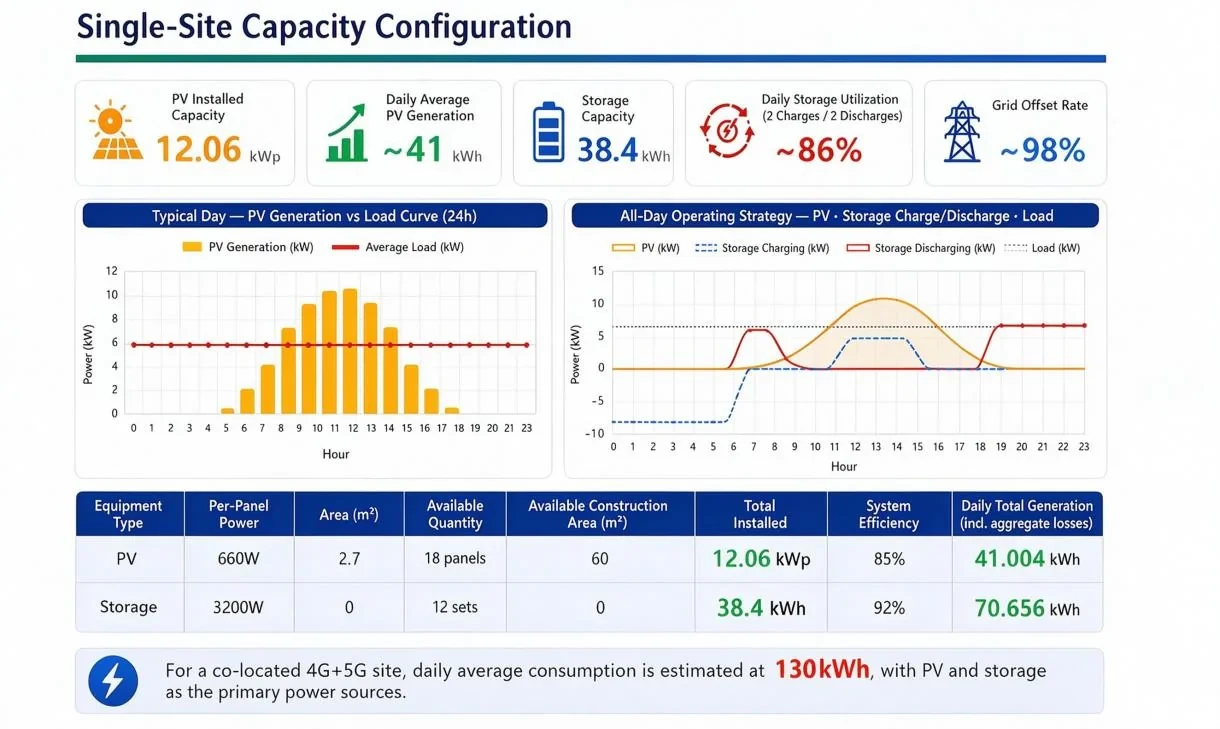
A shared fourth and fifth generation site typically draws on the order of a hundred and thirty kilowatt-hours per day, and that load continues around the clock. The design objective is to serve as much of it as possible from solar and storage while keeping the grid as backup rather than primary supply.
Solar side
A representative configuration uses eighteen six-hundred-and-sixty-watt panels across about sixty square metres of usable area, giving roughly twelve kilowatts peak. At eighty-five percent system efficiency, daily generation lands near forty-one kilowatt-hours. That covers a substantial share of the daily load and provides midday surplus for storage.
Storage side
The storage block in the same configuration totals roughly forty-eight kilowatt-hours across twelve units of a few kilowatt-hours each. With ninety-two percent efficiency, usable daily throughput approaches seventy kilowatt-hours of charge and discharge activity. Duration is the key parameter: it is what carries the site through the evening and overnight hours.
How the pieces fit
Solar covers daytime load and charges storage; storage covers the night and the peak hours; the grid covers the remainder and provides resilience. Because capacity is modular, a site with a heavier load or a weaker grid can add units without redesigning the electrical architecture, and a site with a strong grid can size smaller.
Siting the array and the enclosure
The generation area and the mounting positions should be chosen together. Prefer uniform rows with predictable shading, and avoid positions where the enclosure would sit in the hottest part of the array without airflow. Where the terrain is uneven, treat the most representative rows as the pilot area so the measured result can be applied to the rest of the site with reasonable confidence.
Agreeing the measurement plan
Before installation, agree what will be measured, with which instruments and at what interval. Include a control area, the reporting format, and who receives the monthly summary. A measurement plan written in advance prevents the most common post-commissioning dispute, which is not about performance but about which data the parties consider authoritative.
Tracking seasonal performance
A base-station configuration that balances well in summer may leave the site short in winter, when generation falls faster than load. Compare monthly generation, storage throughput and grid import across a full year, then check whether the reserve rule held through the weakest month. Where it did not, the answer is usually a modest capacity addition rather than a redesign, which is the practical benefit of modular sizing.
Validation before deployment
Confirm the site's actual load profile over at least a month, verify the usable area and structural capacity, and check local rules on roof-mounted generation at telecom sites. Sizing from a measured profile rather than a nominal figure is what keeps a pilot's economics close to its model.
Want this analyzed for your plant?
Send your array data and we will return a technical view within one business day.
Literature search entries on Telecom Base Station Green-Power Solution
The entries below open literature search results rather than single papers, so the reading list can be filtered by date, citation count and full-text availability at the source. 24 queries across five indexes, grouped by source.
Google Scholar1
Semantic Scholar1
Baidu Scholar1
IEEE Xplore1
ScienceDirect1
OpenAlex19
- PV diesel hybrid telecom base station
- 48V DC microgrid telecommunication
- solar power system telecom tower
- energy management telecom base station 5G
- green power supply base station feasibility
- telecom power supply renewable hybrid
- 5G base station solar battery
- diesel generator optimization telecom
- DC power system telecom site
- energy efficiency telecom network
- base station photovoltaic system
- off-grid telecom renewable power
- lithium battery telecom tower
- hybrid power supply telecommunication
- solar powered remote telecom
- green energy base station
- battery backup telecom system
- photovoltaic diesel hybrid telecom
- DC microgrid telecom application
Take the Numbers With You
The brochure covers the storage rod, the five safety layers, the gateway and the cloud platform. Download it, or send us your site conditions for a proposal within one business day.