A 24-Hour Solar-Storage-Grid Dispatch Timeline
Time-of-use pricing turns a day into bands. A simple dispatch policy across those bands does most of the work in cutting grid cost.
Key takeaways
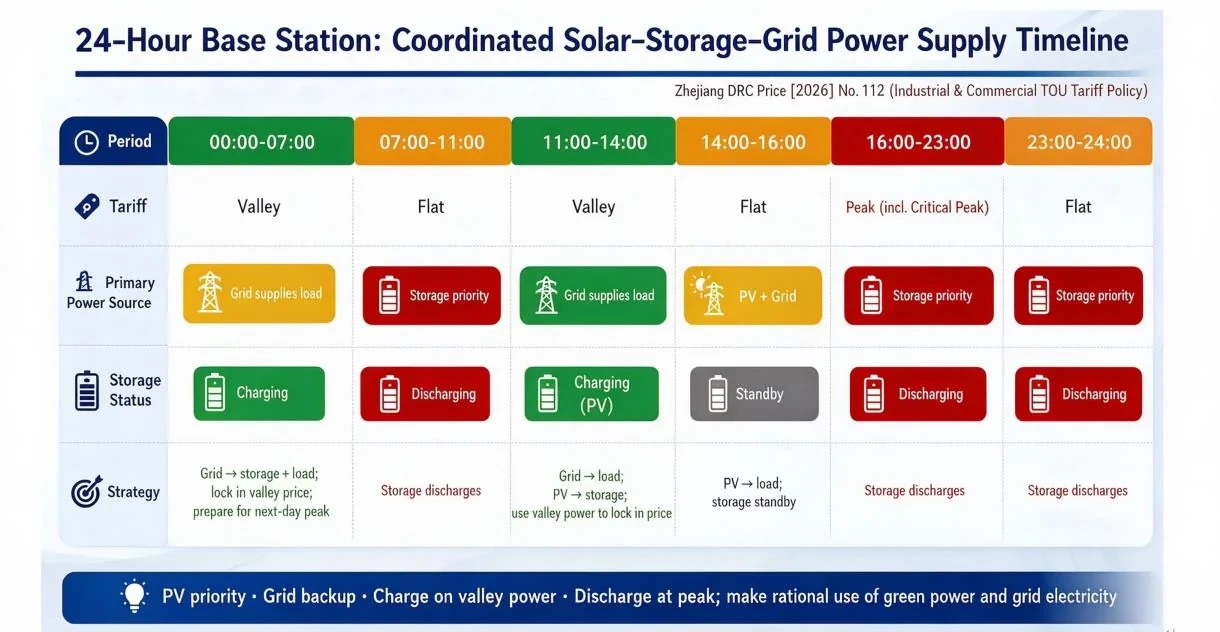
Band-based strategy
Under time-of-use pricing, the day divides into low, flat and peak tariff periods. A workable policy charges storage during low-cost hours, discharges during peak hours, and lets solar serve the load whenever it is available. The rules are simple enough to run locally at the site, which is important when connectivity is unreliable.
Walking through the day
Overnight, the site runs on mains while storage charges on valley power. Through the morning peak, storage discharges into the load. At midday, solar carries the station and refills storage. In the afternoon, the site runs steadily with storage on standby. In the evening peak, storage discharges again, and the cycle repeats.
Solar priority, grid backup
Within that schedule, solar has priority whenever it is available, and the grid supplies what solar and storage cannot. That ordering keeps fuel and purchased energy low while preserving resilience. Where the site previously ran a diesel generator during outages, storage can carry short interruptions and reduce generator starts.
Configuring the policy
Four settings define behaviour: the state-of-charge window, the charge source priority, the discharge threshold and the reserve level kept for outages. Getting these right matters more than the hardware specification, and they should be documented so that a site's operating team can adjust them as tariffs change.
Adapting the policy to local tariffs
Tariff structures differ, and a policy written for one market will underperform in another. Check how many bands exist, when they change, whether weekends differ and whether demand charges apply. Then re-map the charge and discharge windows accordingly. The hardware is unchanged; only the schedule needs rethinking, which is a task the local operating team can handle.
Capturing evidence of fuel savings
Where a generator remains on site, log its running hours and fuel consumption before and after the change. Fuel records are convincing because they come from the operator's own paperwork rather than from a monitoring platform. A single quarter of before-and-after fuel data often carries more weight in a rollout decision than a year of telemetry.
Handling grid outages mid-cycle
Outages interrupt the schedule, and the policy must say what happens next. A workable rule keeps a reserve that is only released when the grid disappears, then recharges preferentially once power returns. Without such a rule, a site can be left with empty storage at the start of a peak period it was supposed to cover, which looks like equipment failure to the site team even when the settings caused it.
How to evaluate performance
Compare grid import cost, generator runtime and storage cycles before and after implementation, in the same tariff bands. Then review whether the reserve level was ever needed and whether any peak hours went uncovered. Those three checks usually identify a policy improvement within the first billing cycle.
Want this analyzed for your plant?
Send your array data and we will return a technical view within one business day.
Literature search entries on Telecom Base Station Green-Power Solution
The entries below open literature search results rather than single papers, so the reading list can be filtered by date, citation count and full-text availability at the source. 24 queries across five indexes, grouped by source.
Google Scholar1
Semantic Scholar1
Baidu Scholar1
IEEE Xplore1
ScienceDirect1
OpenAlex19
- PV diesel hybrid telecom base station
- 48V DC microgrid telecommunication
- solar power system telecom tower
- energy management telecom base station 5G
- green power supply base station feasibility
- telecom power supply renewable hybrid
- 5G base station solar battery
- diesel generator optimization telecom
- DC power system telecom site
- energy efficiency telecom network
- base station photovoltaic system
- off-grid telecom renewable power
- lithium battery telecom tower
- hybrid power supply telecommunication
- solar powered remote telecom
- green energy base station
- battery backup telecom system
- photovoltaic diesel hybrid telecom
- DC microgrid telecom application
Take the Numbers With You
The brochure covers the storage rod, the five safety layers, the gateway and the cloud platform. Download it, or send us your site conditions for a proposal within one business day.