Dispersed Cells vs One Battery Cluster
Architecture decides what a single fault can reach. Concentration and separation are fundamentally different risk postures.
Key takeaways
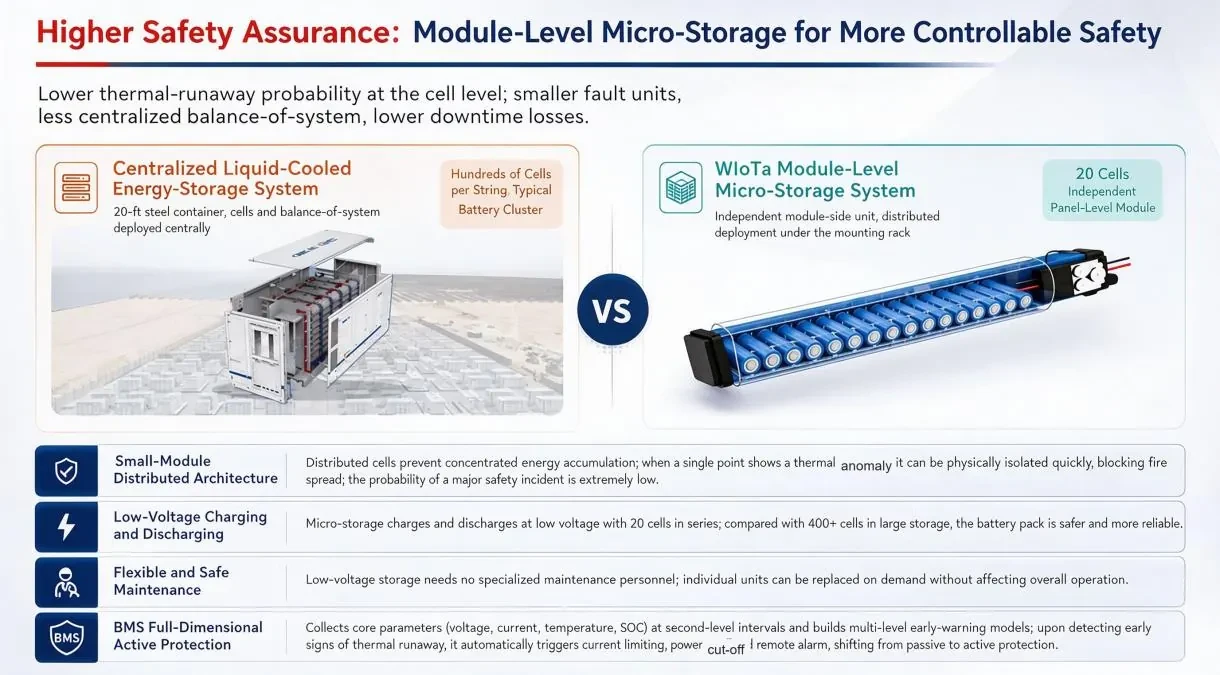
Comparing the two geometries
A central liquid-cooled system gathers hundreds of cells into a single cluster in a container with a dedicated thermal loop. A distributed system spreads small modules, each with a handful of cells, across the array beneath the rails. The difference is not cosmetic: it determines how much energy one fault can involve and how many cells share a thermal environment.
Fault isolation behaviour
When energy is concentrated, an abnormality in one cell can affect the whole cluster and its surroundings. When energy is dispersed, an abnormal module is physically separated and can be isolated quickly, which limits the fire path to a small volume. Concentration raises the potential consequence of any single event; separation reduces it.
Voltage and pack safety
Series count matters. Hundreds of cells in series produce high pack voltage and correspondingly higher stress on insulation and connections. A distributed rod with around twenty cells in series operates at low voltage, which is a simpler safety problem to manage and easier to qualify with protection standards.
Maintenance reality
Central systems need specialist crews, scheduled outages and thermal management upkeep. Distributed units can be replaced individually by a site technician using standard tools while the plant continues to operate. That difference changes both the operating cost and the risk profile during maintenance activity, which is when many incidents begin.
Replacement as a safety feature
Replaceable small units improve safety in a way that is easy to overlook. A unit can be taken out of service immediately when it shows an anomaly, without stranding a large portion of the asset's capacity and without a specialist crew on site. That speed of removal is itself a risk control, and it keeps the maintenance action proportionate.
Cost of the two postures
Concentration typically lowers hardware cost per kilowatt-hour and raises the cost of civil works, cooling and specialist maintenance. Separation raises hardware cost per kilowatt-hour and lowers civil, thermal and maintenance costs while reducing the size of the worst-case event. Both should be presented with their full cost sets rather than on one dimension.
Firefighting access differences
A container requires a defined approach, clearance and often a water supply arrangement. Small modules distributed under the rails present a different picture: many separated ignition points, but very little energy at each. Discuss the layout with the local fire authority before installation and document the outcome, because an access plan agreed in advance is what prevents a design change during commissioning.
What an investor should conclude
Concentration buys scale economics and centralized control. Separation buys isolation, replaceability and a smaller worst-case event. Neither is universally superior, but the trade-off should be explicit in the decision record rather than reduced to a single safety adjective on a slide.
Want this analyzed for your plant?
Send your array data and we will return a technical view within one business day.
Literature search entries on Five-Layer Safety & DC Arc Rapid Shutdown
The entries below open literature search results rather than single papers, so the reading list can be filtered by date, citation count and full-text availability at the source. 24 queries across five indexes, grouped by source.
Google Scholar1
Semantic Scholar1
Baidu Scholar1
IEEE Xplore1
ScienceDirect1
OpenAlex19
- DC arc fault detection photovoltaic rapid shutdown
- lithium ion battery thermal runaway propagation
- PV DC arc fault protection standard
- distributed battery system safety design
- rapid shutdown device NEC requirements
- battery protection circuit PV
- arc fault circuit interrupter DC
- PV rapid shutdown UL3741
- thermal runaway prevention lithium battery
- system safety certification photovoltaic
- DC arc detection algorithm
- overcurrent protection PV system
- insulation monitoring DC microgrid
- lithium iron phosphate safety tests
- ground fault protection solar array
- battery thermal management design
- UL 9540 energy storage safety
- NEC 2017 rapid shutdown
- spark detection photovoltaic system
Take the Numbers With You
The brochure covers the storage rod, the five safety layers, the gateway and the cloud platform. Download it, or send us your site conditions for a proposal within one business day.