Retrofitting Without Stopping Generation
Commissioning a retrofit while the plant keeps exporting changes the sequencing, the labor plan and the risk profile of the whole project.
Key takeaways
- On an operating plant, an interruption day costs the day's generation plus any contractual consequences.
- Section-by-section commissioning needs the operator's agreement on a few practical points: which circuits may be worked in a given window, what electrical checks are required before a sec...
- Confirm rail and module compatibility, per-row access and handling, the addressing scheme, and the electrical checks the operator will accept before a section returns to service.
Why outages are the expensive part
On an operating plant, an interruption day costs the day's generation plus any contractual consequences. Central storage work concentrates that cost into a single block: every string tied to the equipment comes offline at once, and the schedule depends on the equipment's commissioning sequence. Distributed work spreads the same scope across many small windows.
Section-by-section commissioning
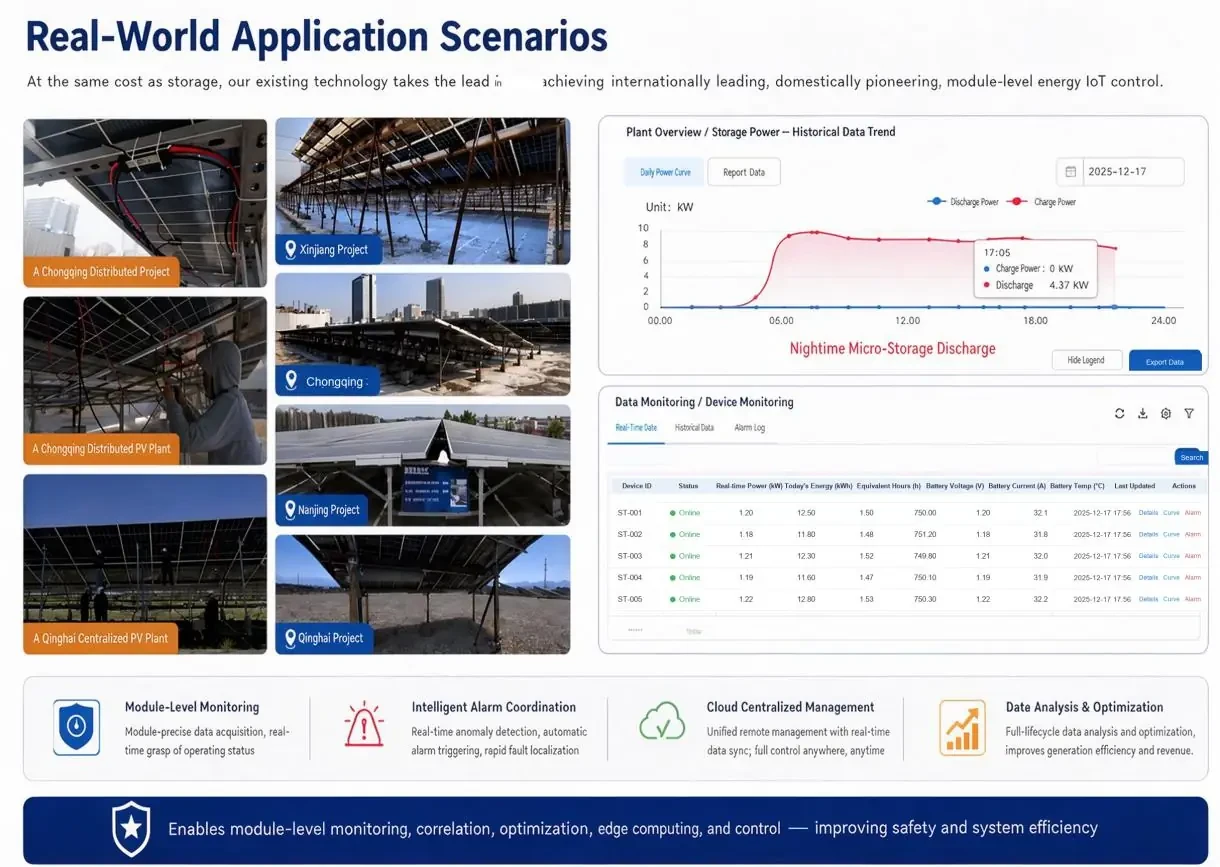
With rail-mounted rods, the crew treats the array as a series of working sections. A section is clamped, wired, addressed and verified, then returned to service. The rest of the plant never notices. The practical limit on daily progress is crew size and the physical handling of rods, not the plant's electrical state, which makes scheduling far more tolerant of weather and staffing.
What this does to the labor plan
Distributed deployment favors small, trainable crews using standard tools rather than a specialty commissioning team on a compressed window. Work can be paused at any section boundary, which matters on sites with harvest, maintenance or inspection seasons. And because each rod is independently addressable, fault-finding during commissioning is local rather than systemic.
Risk through the project
The riskiest moment in a retrofit is the cutover, when new equipment takes responsibility for live circuits. Distributed deployment shrinks that moment to one row. If a compatibility issue appears, it appears in a controlled scope, and the mitigation is to pause expansion rather than to restore a plant. That is a fundamentally different failure mode for the project manager.
Preparing the operator for section work
Section-by-section commissioning needs the operator's agreement on a few practical points: which circuits may be worked in a given window, what electrical checks are required before a section returns to service, who signs off each section, and how a rollback would be executed. Agreeing these in advance turns a series of informal requests into a schedule the site can plan around.
What a working week looks like
In practice, a small crew typically completes a defined number of rows per day, limited by handling, clamping, wiring and verification rather than by electrical risk. Because progress is counted in rows, an interrupted day costs one day's scope instead of the whole commissioning window, and weather delays no longer threaten the completion date.
Tooling and handling
Section work depends on simple logistics: how a unit is carried along a row, where it is set down, what torque tool is used and how cables are supported during the work. Planning those details keeps a crew of two or three productive for the whole day and avoids the improvisation that damages connectors. On large arrays, handling time rather than electrical work usually sets the daily completion rate.
What to verify before starting
Confirm rail and module compatibility, per-row access and handling, the addressing scheme, and the electrical checks the operator will accept before a section returns to service. Agree a daily progress rate and a rollback step. Done properly, the operator's performance obligations are never at risk, which is usually the difference between an approved pilot and a rejected one.
Want this analyzed for your plant?
Send your array data and we will return a technical view within one business day.
Literature search entries on Executive Summary & Product Positioning
The entries below open literature search results rather than single papers, so the reading list can be filtered by date, citation count and full-text availability at the source. 28 queries across five indexes, grouped by source.
Google Scholar1
Semantic Scholar1
Baidu Scholar1
IEEE Xplore1
ScienceDirect1
OpenAlex23
- DC coupled distributed energy storage photovoltaic
- module level MPPT battery storage
- per-panel power optimization PV
- distributed storage retrofit existing solar plant
- DC micro-storage under PV module
- solar plus storage business model
- residential PV battery economic analysis
- PV self-consumption optimization storage
- distributed generation energy storage value
- photovoltaic battery system performance evaluation
- energy storage system photovoltaic plant
- distributed solar storage grid stability
- PV installation with energy storage
- behind-the-meter solar battery
- smart PV module energy storage
- energy shift photovoltaic storage
- PV power plant storage integration
- module integrated storage photovoltaic
- rooftop solar battery system
- photovoltaic storage techno-economic analysis
- solar storage hybrid inverter market
- photovoltaic ess integration standards
- distributed energy resources aggregation
Take the Numbers With You
The brochure covers the storage rod, the five safety layers, the gateway and the cloud platform. Download it, or send us your site conditions for a proposal within one business day.