Comparing Three Add-Storage Paths for an Operating Plant
Containerized BESS, central DC-coupled storage and panel-mounted rods solve different constraints. Comparing them on land, downtime and capex keeps the choice rational.
Key takeaways
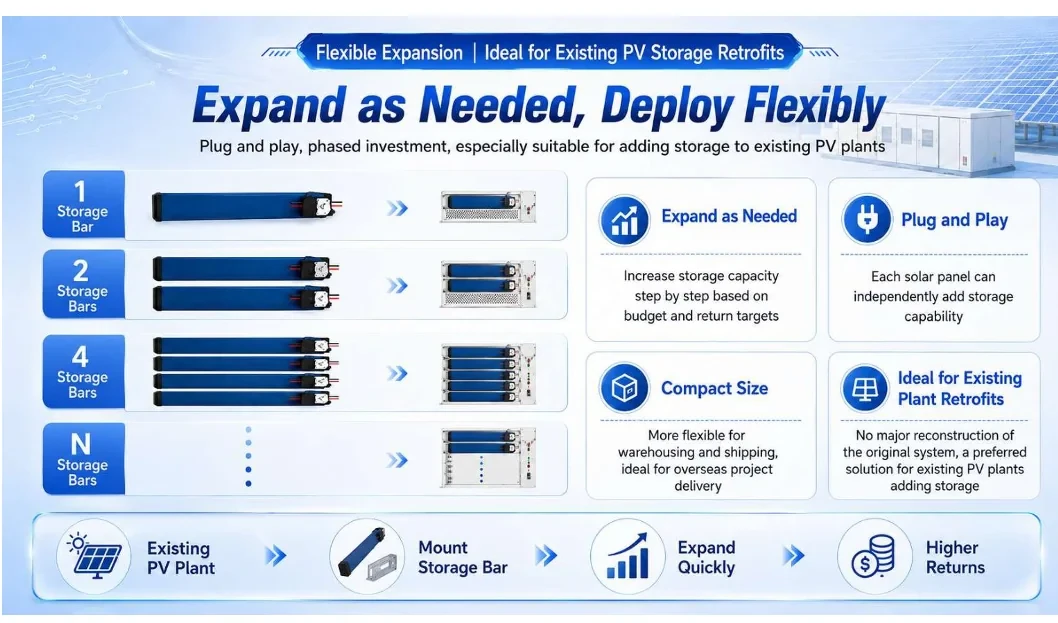
Three paths, three constraints
Every retrofit decision is a negotiation with three constraints: available area, acceptable interruption and capital timing. Containerized battery systems optimize for scale and cost per kilowatt-hour, and they pay for it with land, foundations and a fire-engineering scope. Central DC-coupled storage optimizes for integration and often assumes inverter work. Panel-mounted rods optimize for land-free, interruptible-free deployment and accept a higher cost per kilowatt-hour.
Land and civil works
A container needs a reserved plot, a concrete base and access roads for lifting equipment. On crowded rooftops or desert arrays with fixed row spacing, that plot often does not exist. Panel-mounted rods hang under rails that are already installed, so the civil scope is a torque wrench and a compatibility check. In tender terms, that removes land reservation, land-use approval and site access from the critical path.
Downtime and commissioning style
Central equipment is commissioned as a block: strings come offline, the plant exports less, and the work window is dictated by the equipment, not the operator. Distributed rods commission per row. The crew works a section at a time, and the rest of the plant is untouched. For plants with performance obligations, that difference is often worth more than a per-unit price advantage.
Capex shape and phasing
Containers arrive as one large commitment. Rods can be bought a row, a zone or a phase at a time, so spend follows demonstrated benefit. If phase one delivers the modeled gain, phase two proceeds; if not, exposure stops at the pilot. That optionality changes how a project survives an internal investment committee, especially where the storage business case depends on tariff rules that may still evolve.
How tender documents decide the outcome
The path is often chosen before anyone compares it, because the specification was written around one architecture. If a tender requires a battery cabin, a foundation and a high-voltage scope, distributed storage cannot be evaluated on merit. Writing the requirement as an outcome, such as delivered energy per treated row with no new footprint, keeps the comparison honest.
When the container still wins
Containers remain the better answer when a site has open ground, heavy lifting equipment on hand, a single large budget line and an operator willing to accept a commissioning window. Utility-scale procurement also favours them on financing familiarity. A credible proposal names those conditions rather than claiming one architecture suits every plant.
How early the choice gets locked in
In most projects the architecture is fixed long before the tender is written, during the feasibility study that produced the reference design. That study typically assumes a cabin, a footprint and a grid study because those assumptions were available. Reviewing the reference design before it hardens is the single most effective moment to introduce a distributed alternative, and it costs nothing but a conversation.
Choosing without ideology
None of the three paths is universally right. If the site has open land, a single large procurement and a tolerant operator, containers remain efficient. If the site is tight, busy and phased, panel-mounted storage is the lower-risk route. The honest comparison is not storage versus storage; it is which constraint the buyer is least able to spend.
Want this analyzed for your plant?
Send your array data and we will return a technical view within one business day.
Literature search entries on Executive Summary & Product Positioning
The entries below open literature search results rather than single papers, so the reading list can be filtered by date, citation count and full-text availability at the source. 28 queries across five indexes, grouped by source.
Google Scholar1
Semantic Scholar1
Baidu Scholar1
IEEE Xplore1
ScienceDirect1
OpenAlex23
- DC coupled distributed energy storage photovoltaic
- module level MPPT battery storage
- per-panel power optimization PV
- distributed storage retrofit existing solar plant
- DC micro-storage under PV module
- solar plus storage business model
- residential PV battery economic analysis
- PV self-consumption optimization storage
- distributed generation energy storage value
- photovoltaic battery system performance evaluation
- energy storage system photovoltaic plant
- distributed solar storage grid stability
- PV installation with energy storage
- behind-the-meter solar battery
- smart PV module energy storage
- energy shift photovoltaic storage
- PV power plant storage integration
- module integrated storage photovoltaic
- rooftop solar battery system
- photovoltaic storage techno-economic analysis
- solar storage hybrid inverter market
- photovoltaic ess integration standards
- distributed energy resources aggregation
Take the Numbers With You
The brochure covers the storage rod, the five safety layers, the gateway and the cloud platform. Download it, or send us your site conditions for a proposal within one business day.