Why Existing Solar Plants Are the Real Add-Storage Market
New-build storage gets the attention, but the nearer-term opportunity sits in plants that already exist, already export and cannot spare land.
Key takeaways
The gap in the storage conversation
Most storage pitches start with a greenfield project. That framing skips the assets that need flexibility most: plants that already hold land, grid connections and operating permits, but were designed under assumptions about curtailment and pricing that have since moved. [1]Adding storage to those plants is not an engineering novelty. It is a commercial correction, and it usually has to happen without new land and without long outages.
What an operating plant cannot give up
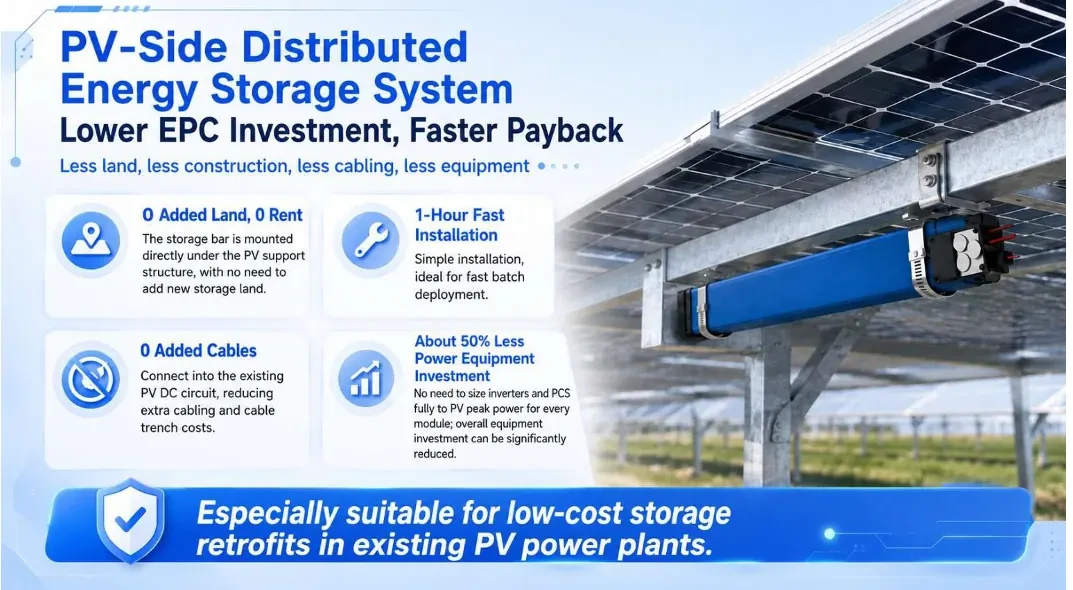
Three things are effectively non-negotiable on a running site. Land: a container system needs a reserved plot plus foundations. Generation hours: string and central replacements interrupt export. Grid status: inverter replacement can trigger re-application work. Each of those costs money and calendar time that the original asset was never sized to carry, which is why retrofit storage often stalls after the feasibility report.[2]
What panel-mounted storage changes
A hanging storage rod mounts on the module rail beneath the panels. Each rod carries its own MPPT optimizer, battery management, DC arc-fault shutdown and a wireless mesh node, and it stores energy on the DC side of the plant. [3]The original inverter, cabling and grid connection stay in place. Installation is bolt-on and measured in hours per row, so commissioning can proceed string by string while the plant keeps exporting.
A four-question fit test
Before any technical work, four questions separate a real opportunity from a dead end. [4]Is there spare land? How expensive is an interruption day? What does the insurer think about concentrated batteries? Do local content or subsidy rules apply? If land is scarce, interruption days are costly, or the buyer wants capacity in phases, the distributed path usually wins on total cost of ownership rather than on unit price.
What a first-year pilot should measure
Three measurements decide whether the retrofit is real. Delivered energy per treated row compared with an untreated control row, discharge energy actually used rather than merely available, and availability of the dispatch path. Collected over a full year, including the shoulder seasons, these three numbers describe the asset far better than any single peak-day screenshot.
Where the retrofit argument breaks down
The argument weakens when land is genuinely free, when the plant is new enough that a redesign is still possible, and when the operator has a large capital budget and no interest in phasing. In those conditions a central system can be the lower-cost answer. Saying so plainly is what makes the retrofit case credible when the conditions do fit.
What buyers ask in month one
The questions that arrive in the first month of a pilot are consistent: what happens if a device fails while the plant is exporting, how long a swap takes, and whether the monitoring platform can be shared with the operating team's existing system. Answering these three in the proposal, rather than at the first site visit, shortens the path from interest to installation and prevents the retrofit from being deferred for another budget cycle.
Start with evidence, not a promise
The practical next step is a small pilot: a few dozen rods on representative rows, instrumented so the buyer sees yield, discharge and availability on their own meter. Measured performance on their own site beats any brochure figure, and it converts the second purchase from a leap of faith into a budget line. That is the whole retrofit argument in one sentence.
Retrofit time and installation details
A single storage bar clamps under the existing rail and joins the string electrically. The figures below are the ones a construction planner needs before scheduling a retrofit window. The field notes column covers what each figure changes on site.
| Parameter | Value | Field note |
|---|---|---|
| Crew and tooling | Local PV crew, standard tools | No dedicated assembly line and no special tooling at the site. |
| Commissioning | Per string, wireless mesh to gateway | Each string is verified in EMS as soon as it is completed. |
| Retrofit time | ~15 min per DC retrofit | Measured per string on the 100 MW retrofit; the plant keeps exporting throughout. |
| Plant downtime | None | Work proceeds string by string during normal operation, not in a shutdown window. |
| Mounting method | Clamp-on, weld-free, rail-mounted | Fits the existing module rail; no drilling, welding or civil foundation. |
| Bar weight | ~28 kg | One-person lift with the equipment a PV crew already carries. |
Measured on the 100 MW retrofit and MW-scale validation sites.
Want this analyzed for your plant?
Send your array data and we will return a technical view within one business day.
Kingneed Energy Engineering Team
The team designs and commissions panel-mounted storage for existing PV plants. Blog entries are written from field commissioning records, retrofit feasibility work and the product reference pack, not from press material.
- Published
- 2026-10-16
- Technical review
- Reviewed by the retrofit engineering group in Zhongshan before publication
- Reading time
- 4 min read
Figures in the text can be traced through the numbered references below. If a figure no longer matches the current specification, write to gao@kingneed.cn and the article will be corrected with a dated note.
How this argument is built
The piece on "Why Existing Solar Plants Are the Real Add-Storage Market" moves through the steps below: the field problem, the mechanism behind it, and the quantities that decide the answer. Each step links to a literature search, so the reasoning can be checked against outside work rather than taken on trust.
- 01
The gap in the storage conversation
Most storage pitches start with a greenfield project.
Literature search: The gap in the storage conversation - 02
What an operating plant cannot give up
Three things are effectively non-negotiable on a running site.
Literature search: What an operating plant cannot give up - 03
What panel-mounted storage changes
A hanging storage rod mounts on the module rail beneath the panels.
Literature search: What panel-mounted storage changes - 04
A four-question fit test
Before any technical work, four questions separate a real opportunity from a dead end.
Literature search: A four-question fit test
Figures quoted in the text come from Kingneed's own product reference pack. External links open search results across public indexes rather than single papers, and are meant for verification, not endorsement. Jump to the full reading list (32 queries).
Literature search entries on Executive Summary & Product Positioning
Numbered entries correspond to the footnote markers in the article above. Each opens a literature search rather than a single paper, so the reading list can be filtered by date, citation count and full-text availability at the source. 28 queries across five indexes, grouped by source.
Claim-level searches cited in the text
- [1]framing skips assets need flexibility plants already
- [2]costs money calendar time original asset never
- [3]carries mppt optimizer battery management arc-fault shutdown
- [4]technical work four questions separate real opportunity
Each entry is built from the sentence that carries the marker, so the number in the text and the query here refer to the same claim. Entries further down the list cover the wider topic.
Google Scholar1
Semantic Scholar1
Baidu Scholar1
IEEE Xplore1
ScienceDirect1
OpenAlex23
- [10]DC coupled distributed energy storage photovoltaic
- [11]module level MPPT battery storage
- [12]per-panel power optimization PV
- [13]distributed storage retrofit existing solar plant
- [14]DC micro-storage under PV module
- [15]solar plus storage business model
- [16]residential PV battery economic analysis
- [17]PV self-consumption optimization storage
- [18]distributed generation energy storage value
- [19]photovoltaic battery system performance evaluation
- [20]energy storage system photovoltaic plant
- [21]distributed solar storage grid stability
- [22]PV installation with energy storage
- [23]behind-the-meter solar battery
- [24]smart PV module energy storage
- [25]energy shift photovoltaic storage
- [26]PV power plant storage integration
- [27]module integrated storage photovoltaic
- [28]rooftop solar battery system
- [29]photovoltaic storage techno-economic analysis
- [30]solar storage hybrid inverter market
- [31]photovoltaic ess integration standards
- [32]distributed energy resources aggregation
Take the Numbers With You
The brochure covers the storage rod, the five safety layers, the gateway and the cloud platform. Download it, or send us your site conditions for a proposal within one business day.