Land: The Hidden Cost Line in Storage Retrofits
Land rarely appears as a line item in storage quotes, yet it decides schedule, approval risk and total cost on many retrofit projects.
Key takeaways
Why land is invisible in the quote
Equipment quotations price hardware. They rarely price the area the hardware occupies, because the vendor assumes the buyer has it. On a brownfield site, that assumption is often wrong. A battery cabin needs a footprint, a separation distance from other infrastructure and access for firefighting. All three are land costs that appear later as approvals, hires and delays.
The approval chain behind a footprint
Once a plot is chosen, the project enters a chain of checks: land-use classification, fire separation, access roads, possibly a change to the plant layout drawings. Each step has an owner and a timeline, and any one of them can push a retrofit past a financing window. Hanging storage sidesteps the chain entirely, because it adds no footprint beyond the module rail that already exists.
Field conditions make the difference bigger
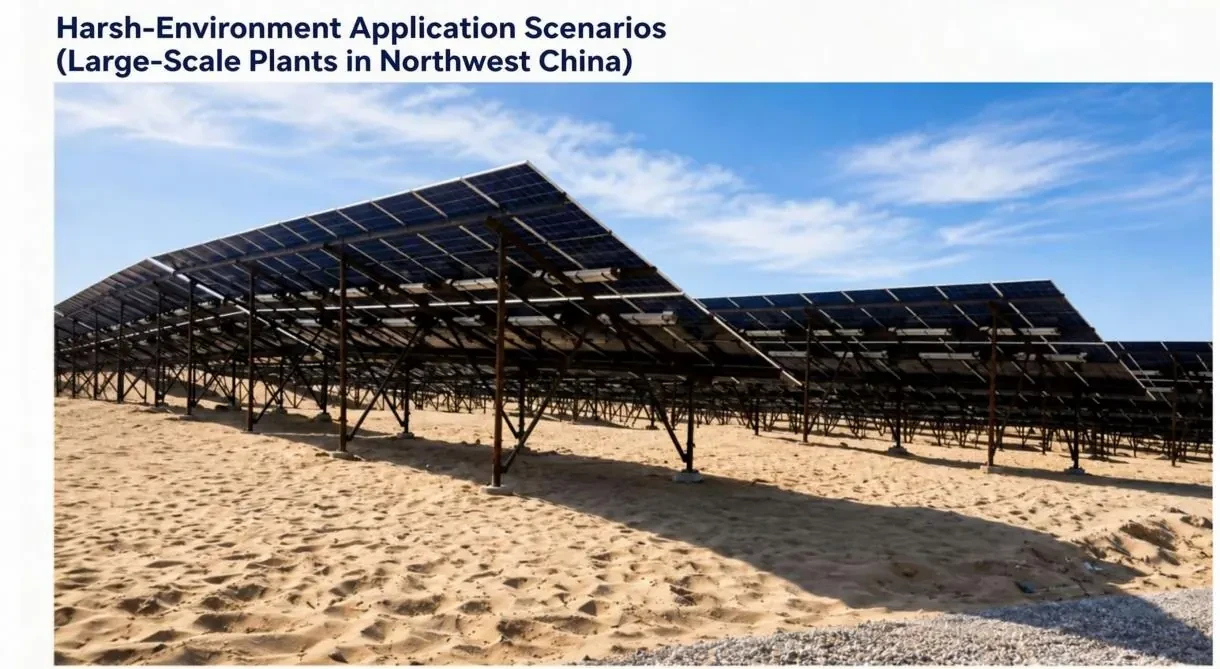
On desert arrays with sandy ground, vehicle access for container delivery is itself a civil project. On rooftops, the limit is structural: most commercial decks were not designed for a cabinet's point loads. On farmland and agri-PV layouts, new hard surfaces can breach land rules. In all three cases, the cheapest land is the land you do not use.
How to price it honestly
When comparing options, add three numbers to the conventional quote: the opportunity cost of the reserved area, the engineering and approval hours behind the footprint, and the schedule risk expressed as delayed revenue. Buyers who run that exercise usually find the distributed option is not more expensive overall, even when its per-kilowatt-hour price is higher.
Reading land cost in a feasibility report
When reviewing a storage feasibility study, look for the footprint assumption. If the study reserves a plot without pricing it, the comparison is incomplete. Add the value of that area at local land rates, the engineering hours for approval, and the delay risk in months. Those three additions frequently change the ranking of options that looked clearly separated on capital cost.
The land you already paid for
An existing plant has already paid for its site, its access and its approvals. A retrofit that uses no additional area is therefore borrowing infrastructure at no incremental cost, while one that reserves a plot is buying a second time. Framing the choice this way moves the discussion from equipment price to the value of assets already owned.
Benchmarking against a no-storage baseline
Every land and cost argument should be measured against what the plant already achieves. Establish a no-storage baseline before any retrofit work: delivered energy, curtailed energy and generation interruption days over the previous year. Without that baseline, gains are estimates; with it, the retrofit is a comparison the owner can audit, and the same baseline later protects the project when seasonal variation is used to question its results.
The design principle
Panel-mounted storage is built around one rule: the retrofit should be invisible to the site plan. No new footprint, no new foundations, no new access requirements. That is why it exports as a rail-mounted product rather than a small container, and why projects with no spare square metre are where it earns its place.
Want this analyzed for your plant?
Send your array data and we will return a technical view within one business day.
Literature search entries on Reference Case: 100 MW Northwest Retrofit & Feasibility Study
The entries below open literature search results rather than single papers, so the reading list can be filtered by date, citation count and full-text availability at the source. 24 queries across five indexes, grouped by source.
Google Scholar1
Semantic Scholar1
Baidu Scholar1
IEEE Xplore1
ScienceDirect1
OpenAlex19
- solar curtailment battery storage capacity sizing
- large scale PV plant curtailment analysis
- energy storage absorbing curtailed solar
- Northwest China PV curtailment study
- dispatchable solar generation storage retrofit
- curtailment reduction economics wind solar
- PV station retrofit 100MW
- energy storage for renewable integration
- grid congestion storage solution
- battery capacity sizing method
- large scale solar curtailment analysis
- storage for solar plant retrofit
- Northwest China renewable curtailment
- feasibility study PV storage
- power plant energy storage system
- peak shaving solar farm
- optimization of storage in PV plant
- economic analysis storage retrofit
- grid friendly photovoltaic storage
Take the Numbers With You
The brochure covers the storage rod, the five safety layers, the gateway and the cloud platform. Download it, or send us your site conditions for a proposal within one business day.