EPC Cost Drivers for Panel-Mounted Storage
Removing the cabin, foundation and high-voltage connection work changes where the money goes in a storage retrofit budget.
Key takeaways
- A conventional storage scope carries four heavy blocks: equipment, civil works, high-voltage connection and thermal management.
- In a distributed retrofit, labor scales with the number of rows rather than with megawatts, which makes productivity assumptions the largest single variable in the estimate.
- Compare total installed cost, not unit price.
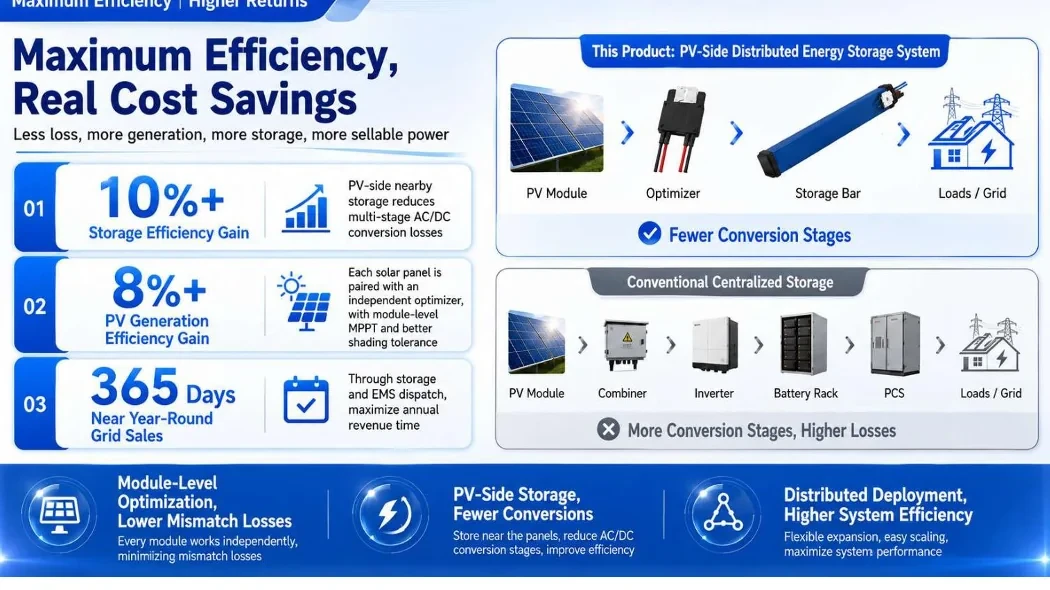
The traditional cost structure
A conventional storage scope carries four heavy blocks: equipment, civil works, high-voltage connection and thermal management. Civil works include foundations, cable trenches and access; the connection block includes switchgear, protection and often a grid study. Thermal management adds air conditioning or liquid cooling and its auxiliary load. On retrofit sites, these blocks are where budgets drift.
What disappears with rail mounting
Hanging storage has no cabin, so there is no base, no dedicated fire-engineering scope and no separate plot. It operates at low voltage on the DC side, so high-voltage connection work is not required. Cooling is passive, so auxiliary power draw drops. What remains is hardware, per-row installation labor, gateway and network setup, and commissioning checks.
Where the money actually goes
In a distributed retrofit, labor is a larger share of cost than in a container project, and it scales with row count rather than with megawatts. That has two implications: accurate row-level productivity assumptions matter more than equipment discounts, and local assembly of housings and harnesses can reduce landed cost meaningfully where tariffs or freight are heavy.
Tender language that protects the budget
Write the scope so latent costs cannot reappear after award. Specify that no additional land, foundation, high-voltage connection or cooling auxiliary is in scope, and require per-row installation productivity to be quoted with the equipment. Also require a written compatibility statement for rail, module frame and inverter. These three clauses remove most of the surprises that turn a retrofit into a re-engineering project.
Where labour dominates the budget
In a distributed retrofit, labor scales with the number of rows rather than with megawatts, which makes productivity assumptions the largest single variable in the estimate. Ask for a per-row figure with the crew size it assumes, and check it against the row geometry of the actual site. A productivity number derived from an open, uniform array will not hold on a cluttered rooftop.
Two clauses that prevent rework
First, a compatibility statement covering rail, module frame and connector types, issued before the order. Second, an acceptance definition for a commissioned section: which measurements are taken, who records them and what threshold counts as complete. Both cost nothing at the tender stage and remove the ambiguity that turns a fixed-price scope into a variation order.
Logistics and customs as cost lines
Freight, duties and port handling vary widely by market and can outweigh small differences in hardware price. Where knocked-down shipment is available, comparing the landed cost of components against the landed cost of finished units is a five-minute exercise that occasionally changes the preferred supply route. Build these lines into the budget rather than discovering them at the warehouse.
Reading a quotation correctly
Compare total installed cost, not unit price. Two proposals with the same hardware number can differ by the cost of a trench, a transformer upgrade or a week of lost generation. The cheapest retrofit is usually the one that adds the fewest new disciplines to the site.
Want this analyzed for your plant?
Send your array data and we will return a technical view within one business day.
Literature search entries on Executive Summary & Product Positioning
The entries below open literature search results rather than single papers, so the reading list can be filtered by date, citation count and full-text availability at the source. 28 queries across five indexes, grouped by source.
Google Scholar1
Semantic Scholar1
Baidu Scholar1
IEEE Xplore1
ScienceDirect1
OpenAlex23
- DC coupled distributed energy storage photovoltaic
- module level MPPT battery storage
- per-panel power optimization PV
- distributed storage retrofit existing solar plant
- DC micro-storage under PV module
- solar plus storage business model
- residential PV battery economic analysis
- PV self-consumption optimization storage
- distributed generation energy storage value
- photovoltaic battery system performance evaluation
- energy storage system photovoltaic plant
- distributed solar storage grid stability
- PV installation with energy storage
- behind-the-meter solar battery
- smart PV module energy storage
- energy shift photovoltaic storage
- PV power plant storage integration
- module integrated storage photovoltaic
- rooftop solar battery system
- photovoltaic storage techno-economic analysis
- solar storage hybrid inverter market
- photovoltaic ess integration standards
- distributed energy resources aggregation
Take the Numbers With You
The brochure covers the storage rod, the five safety layers, the gateway and the cloud platform. Download it, or send us your site conditions for a proposal within one business day.