Per-Panel MPPT and the Cost of Mismatch Loss
Mismatch losses are quiet and cumulative. Tracking each panel independently is the most direct way to recover them on an existing array.
Key takeaways
Where mismatch comes from
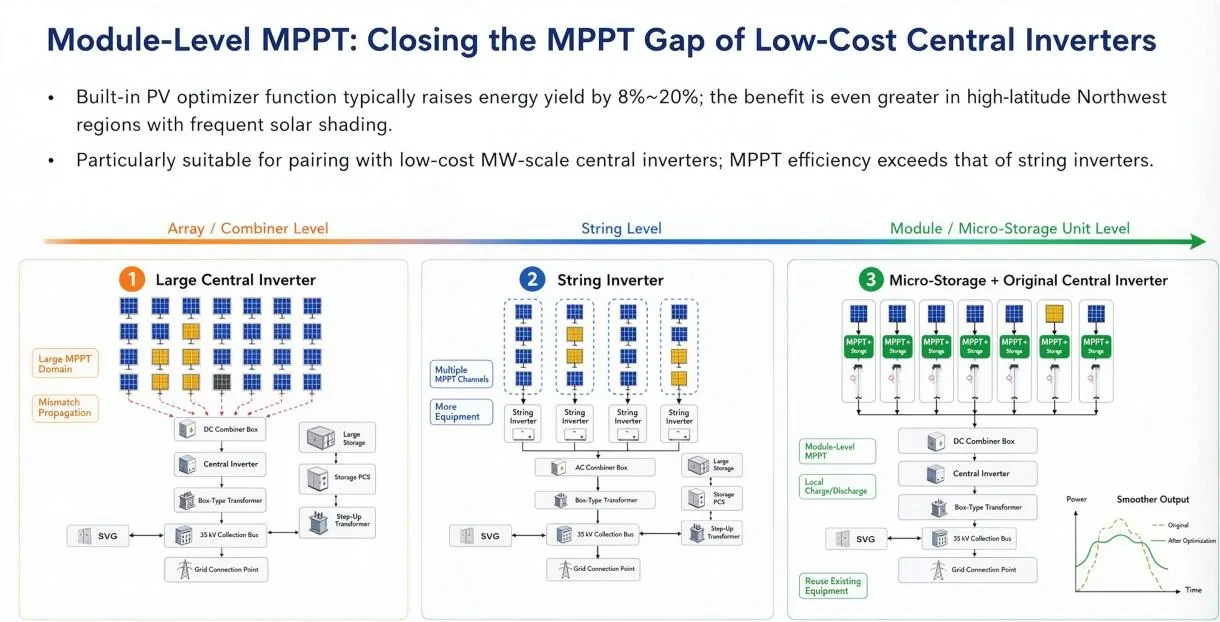
A string is limited by its weakest link. Dust on part of a row, a shading edge from a parapet, uneven soiling after rain, differential module ageing and thermal gradients all push panels onto different operating points. A string-level tracker must choose one compromise point, and every panel away from that point contributes less than it could.
Why it is hard to see
Mismatch does not announce itself. There is no alarm, no fault code, no visible failure; there is only a generation curve that is slightly lower than expected. Because it appears as a small percentage and a slow drift, it is often written off as soiling or ageing, and the loss compounds across the whole array for the lifetime of the plant.
Independent tracking per panel
A per-panel optimizer tracks the maximum power point for its own module, so one panel's shading no longer drags along its neighbours. In a hanging storage rod, that optimizer is built into the same enclosure as the battery management and shutdown functions, which means the retrofit gains tracking and storage from the same installation step instead of two.
Typical gain range
Published experience with module-level optimization puts the energy-yield benefit in the range of eight to twenty percent, with the higher end appearing on arrays that suffer frequent partial shading or high-latitude winter angles. It is a range, not a uniform figure: the honest approach is to measure it on treated rows before quoting it for an entire plant.
How to quantify mismatch on your own site
A practical test costs little. Compare strings with known shading against clean reference strings over several days, using inverter-level data or a clamp meter. Corrections for irradiance and soiling are approximate, but the direction and rough size of the loss become visible. That measurement is far more persuasive to an internal committee than a published range quoted from a data sheet.
Pairing optimization with storage
Optimization and storage reinforce each other. Recovered panel output raises the energy available to charge, and improved conversion efficiency preserves more of what is recovered. Buying them as a single integrated enclosure avoids inserting another conversion stage between the two functions, which is where part of the combined benefit would otherwise be lost.
Ageing modules and mismatch drift
Mismatch is not static. As modules age at different rates, as glass and encapsulant discolour unevenly, and as connectors degrade, the spread between the best and worst module in a string widens. Independent tracking compensates for that drift continuously, which means its benefit tends to grow over the asset's remaining life rather than plateauing in the first year.
Where it matters most
The gain concentrates on the difficult rows: edges, corners, near parapets, under cables, and any array with a history of shading after nearby construction. It also pairs well with low-cost MW-class central inverters, whose single tracking stage cannot resolve per-panel differences. Recovering panel-level output is often cheaper than adding panels, because it needs no new land.
Want this analyzed for your plant?
Send your array data and we will return a technical view within one business day.
Literature search entries on Executive Summary & Product Positioning
The entries below open literature search results rather than single papers, so the reading list can be filtered by date, citation count and full-text availability at the source. 28 queries across five indexes, grouped by source.
Google Scholar1
Semantic Scholar1
Baidu Scholar1
IEEE Xplore1
ScienceDirect1
OpenAlex23
- DC coupled distributed energy storage photovoltaic
- module level MPPT battery storage
- per-panel power optimization PV
- distributed storage retrofit existing solar plant
- DC micro-storage under PV module
- solar plus storage business model
- residential PV battery economic analysis
- PV self-consumption optimization storage
- distributed generation energy storage value
- photovoltaic battery system performance evaluation
- energy storage system photovoltaic plant
- distributed solar storage grid stability
- PV installation with energy storage
- behind-the-meter solar battery
- smart PV module energy storage
- energy shift photovoltaic storage
- PV power plant storage integration
- module integrated storage photovoltaic
- rooftop solar battery system
- photovoltaic storage techno-economic analysis
- solar storage hybrid inverter market
- photovoltaic ess integration standards
- distributed energy resources aggregation
Take the Numbers With You
The brochure covers the storage rod, the five safety layers, the gateway and the cloud platform. Download it, or send us your site conditions for a proposal within one business day.