Who Actually Competes in Module-Level Storage
The competitive map has five camps. Knowing which camp a prospect is comparing you with changes how the discussion should be framed.
Key takeaways
- Large battery container manufacturers compete on scale cost, mature thermal design and brand recognition, and they serve utility tenders well.
- When a prospect compares your product with a claim you cannot match, ask for five items: the product model and data sheet, an under-mount installation photograph with a location, continuo...
- Telecom power specialists own the operator procurement channel and understand DC systems deeply, but they rarely combine generation, storage, optimization and shutdown in one field-mounte...
Camp one: utility container systems
Large battery container manufacturers compete on scale cost, mature thermal design and brand recognition, and they serve utility tenders well. Their constraint in retrofit settings is land, foundations and interconnection work. The conversation should focus on those constraints rather than on a direct comparison of unit economics.
Camp two: string and commercial storage
Established commercial and residential storage brands bring mature channels and complete certification files. They are strong where a cabinet can be placed and independently certified. Their weakness appears precisely where panel-mounted storage is strongest: arrays with no space, no tolerance for interruption and a requirement for per-panel granularity.
Camp three: module-level power electronics
Optimizer and microinverter companies already supply module-level devices at scale, and some have extended toward storage. They have the installed base and the electronics competence, and a launch of storage on top of an optimizer platform is a plausible next step. That makes them the most serious medium-term competitor, and it argues for building channel and certification depth rather than relying on the form factor alone.
Camp four: direct look-alikes
A small number of companies worldwide have pursued under-panel module storage, with one United States firm the closest comparison in form factor. Their commercial experience, including cost, certification, maintenance and channel difficulties, is worth studying carefully rather than dismissing. Verify each feature claim against your own specification before assuming parity.
How to qualify a competitor claim
When a prospect compares your product with a claim you cannot match, ask for five items: the product model and data sheet, an under-mount installation photograph with a location, continuous operating data, a safety test report, and a fault-replacement and compatibility plan. Claims that cannot produce these are design intentions, and the conversation returns to verifiable ground.
Positioning against each camp
Against container systems, lead with land, civil works and commissioning style. Against commercial cabinets, lead with per-panel granularity and sites that cannot host a cabinet. Against module-level electronics vendors, lead with storage on top of optimization and the retrofit scenarios they do not serve. Matching the argument to the competitor is far more effective than repeating one generic message.
Building the moat beyond hardware
The durable advantage in this niche is architectural rather than electrical: mounting under the rail, independent per-unit control, dispersed safety, replaceability, and a supply model that supports local assembly and phased purchase. Component suppliers can be matched; a complete architecture combined with field evidence, a service programme and a channel takes considerably longer to reproduce, which is where the defensibility actually sits.
Camp five: telecom DC power vendors
Telecom power specialists own the operator procurement channel and understand DC systems deeply, but they rarely combine generation, storage, optimization and shutdown in one field-mounted unit. In that segment the competition is as much about qualification cycles and price sensitivity as about features. Ask any claimant for five pieces of evidence: a product model and data sheet, an under-mount project photograph with location, continuous operating data, a safety test report, and a fault-replacement and compatibility plan.
Want this analyzed for your plant?
Send your array data and we will return a technical view within one business day.
Literature search entries on Competitive Landscape & Differentiation
The entries below open literature search results rather than single papers, so the reading list can be filtered by date, citation count and full-text availability at the source. 24 queries across five indexes, grouped by source.
Google Scholar1
Semantic Scholar1
Baidu Scholar1
IEEE Xplore1
ScienceDirect1
OpenAlex19
- SolarEdge vs Enphase microinverter optimizer
- module level power electronics market
- MLPE vs string inverter comparison
- distributed battery storage competitive strategy
- PV optimiser storage integrated product
- Tesla Powerwall competitor analysis
- PV inverter market share
- AC coupled storage systems comparison
- DC coupled system benefits
- smart inverter technology review
- microinverter market growth
- string inverter vs MLPE
- energy storage company market strategy
- home energy management competition
- PV optimizer system topology
- integrated PV storage product design
- distributed battery system competitive
- solar inverter reliability comparison
- product differentiation renewable energy
Take the Numbers With You
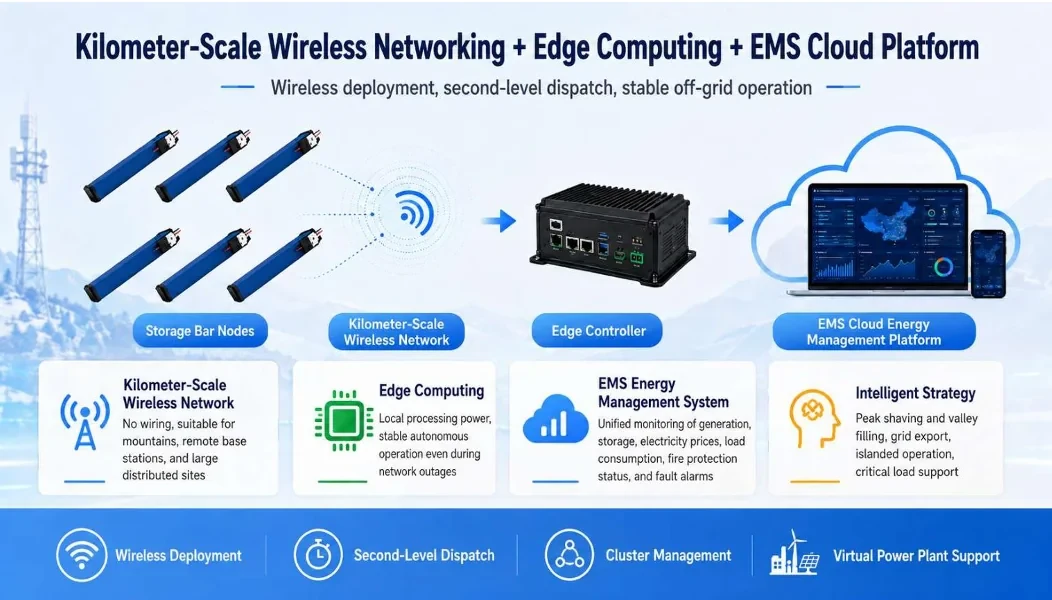
The brochure covers the storage rod, the five safety layers, the gateway and the cloud platform. Download it, or send us your site conditions for a proposal within one business day.