Buyer Questions to Answer Before the First Meeting
Technical buyers converge on a predictable set of questions. Preparing precise answers shortens evaluation cycles more than any presentation.
Key takeaways
- Expect questions about cell chemistry and supplier, capacity and rated power per unit, maximum operating temperature, the safety and transport standards the product holds, thermal testing...
- Structure the meeting around their questions rather than your features.
- Assemble a single evidence pack: data sheet, certificate copies, thermal and mechanical test reports, a compatibility statement, a swap procedure, a reference project summary with continu...
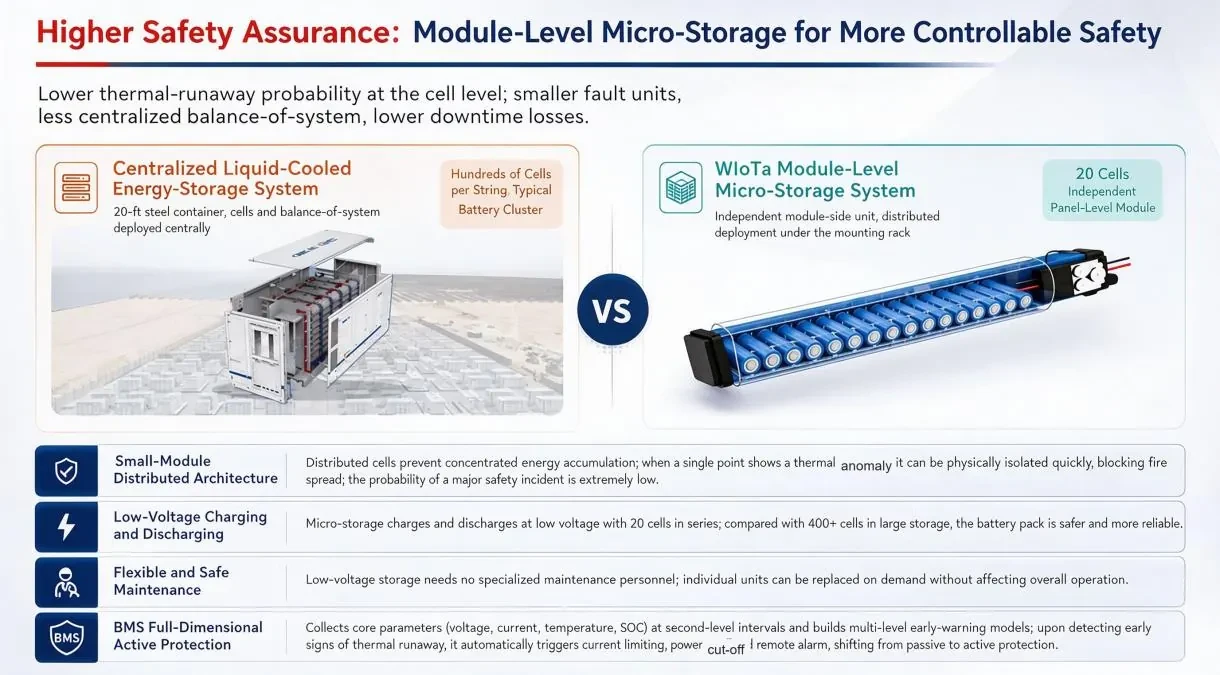
Battery and safety
Expect questions about cell chemistry and supplier, capacity and rated power per unit, maximum operating temperature, the safety and transport standards the product holds, thermal testing evidence, whether a fault in one unit affects its neighbours, and whether under-module mounting raises the module back-sheet temperature. Answer with documents and measured values wherever possible.
Electrical compatibility
Buyers will ask which inverter families have been verified, the DC voltage range, maximum short-circuit current, the module power range supported, whether the device can be inserted into existing strings, whether the retrofit requires a shutdown, what happens in bypass during a fault, and whether the system continues to run if the wireless link drops. A written compatibility statement covering these points is usually the single most requested document.
Mechanical and environmental
Prepare answers on rack load capacity and wind or snow loading, heat, dust, salt-spray and humidity suitability, ingress protection rating, the effect of mounting on ventilation, hot-spot and back-sheet ageing behaviour, and how device life compares with module life. Mechanical and environmental questions are where under-specified proposals are eliminated.
Commercial and service
Expect warranty terms and how degradation is defined, local spare availability, the time to swap a single unit, the maximum number of wireless nodes supported, reference for the largest deployment, offline operating duration, whether the energy management system can follow local tariff rules, and the expected project payback. Vague answers to these four groups cost more deals than any technical shortfall.
Running the technical review meeting
Structure the meeting around their questions rather than your features. Open with the compatibility statement, then safety documentation, then field data, then commercial terms. Technical reviewers form their judgement early, and answering their specific document requests in that order keeps the session productive instead of turning it into a product presentation.
Following up with evidence
Send the requested documents within a day, indexed to the questions asked. Track which items were requested and which remain outstanding, and chase test reports rather than promises. The organisation that responds with paperwork rather than reassurance usually wins the technical evaluation, because its claims can be verified without a second meeting.
Closing the loop after delivery
Send the buyer a short commissioning summary once the system is running: what was installed, the readings taken, the strategy configured and the contact path for support. Then send one review after the first full season. Those two documents convert a delivered order into a reference, and they are usually the reason a second site is discussed before the first contract has ended.
How to prepare
Assemble a single evidence pack: data sheet, certificate copies, thermal and mechanical test reports, a compatibility statement, a swap procedure, a reference project summary with continuous data, and a payback template. Keep it under twenty pages. The goal is to let the buyer's own engineers verify the claims without a series of follow-up emails.
Want this analyzed for your plant?
Send your array data and we will return a technical view within one business day.
Literature search entries on Target Markets & Country Priority
The entries below open literature search results rather than single papers, so the reading list can be filtered by date, citation count and full-text availability at the source. 24 queries across five indexes, grouped by source.
Google Scholar1
Semantic Scholar1
Baidu Scholar1
IEEE Xplore1
ScienceDirect1
OpenAlex19
- global PV storage market analysis
- energy storage policy incentive country comparison
- distributed solar market India Africa
- telecom tower off-grid market renewable
- PV storage certification international standards
- solar energy storage policy Europe
- emerging markets off-grid solar
- energy storage potential Southeast Asia
- Latin America photovoltaic growth
- Middle East solar market
- India renewable energy storage
- Africa telecom tower solar
- United States PV storage incentives
- Australia battery photovoltaic market
- China distributed energy storage policy
- Japan residential solar storage
- Germany home battery adoption
- Brazil solar power expansion
- renewable energy investment developing countries
Take the Numbers With You
The brochure covers the storage rod, the five safety layers, the gateway and the cloud platform. Download it, or send us your site conditions for a proposal within one business day.