Choosing Beachhead Markets for Panel-Mounted Storage
A credible market entry starts with segments where constraints are acute, not with the largest addressable market on a slide.
Key takeaways
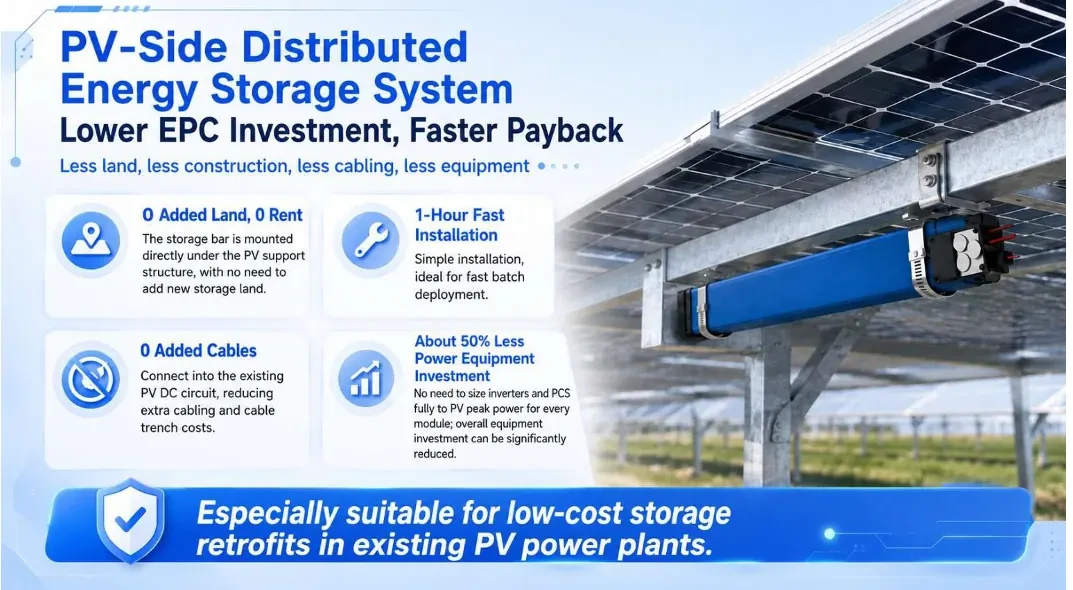
- Panel-mounted storage is compelling where land is unavailable, construction cannot interrupt production, and capacity is bought in phases.
- A reference project is only useful if it answers the questions the next customer will ask.
- A practical sequence: prove the technology domestically on a large old-plant retrofit, standardise a package for telecom sites, then establish one reference partner in a lead market befor...
Look for acute constraints
Panel-mounted storage is compelling where land is unavailable, construction cannot interrupt production, and capacity is bought in phases. Markets with fast-growing solar deployment, cost-sensitive buyers, weak grids and local content rules concentrate all three constraints, which is why they are the natural starting points rather than the markets with the largest installed base.
Segments before countries
Within any country, the productive entry point is a segment: telecom tower operators, existing plant owners and independent power producers, off-grid industrial loads, and constrained commercial rooftops. Each has a distinct buying process and a distinct benchmark for value. Entering country by country without choosing a segment spreads effort and produces pilots that never convert.
Channel partner characteristics
The partner that works is usually a photovoltaic EPC contractor, a telecom energy provider, an inverter or storage distributor, or a local assembler with an existing maintenance footprint. Their technical team can validate the product, and their relationships shorten the path to a reference project. One well-resourced partner delivering a reference site is worth more than several unfocused appointments.
Why local assembly matters
In markets with high import duties and local-manufacturing incentives, knocked-down shipment and local housing assembly can qualify for rebates or subsidy programs that whole-unit imports do not. That changes project returns directly, and it gives a local partner a commercial role beyond distribution, which tends to make the relationship more durable.
What a reference site must prove
A reference project is only useful if it answers the questions the next customer will ask. Choose one that demonstrates the specific constraints you intend to sell against: no spare land, no generation interruption, phased purchase, or local assembly content. A visually impressive site that does not exhibit those constraints proves much less than a modest one that does.
Choosing the first partner
Prefer a partner with an existing technical team and maintenance footprint over one with the largest sales force. Their engineers will validate the product, their technicians will keep it running, and their reputation is at stake alongside yours. That combination shortens the path to a credible reference more reliably than aggressive early volume commitments.
Learning from adjacent industries
Distributed monitoring and staged infrastructure rollouts are familiar problems in telecom and in industrial equipment leasing. Borrowing practices from those sectors, such as standardised site surveys, device registries and swap programmes with defined turnaround times, shortens the learning curve considerably. The engineering is new; most of the field operations are not.
Sequencing
A practical sequence: prove the technology domestically on a large old-plant retrofit, standardise a package for telecom sites, then establish one reference partner in a lead market before broadening. Each stage produces evidence that makes the next conversation easier, which is a cheaper growth path than parallel market launches.
Want this analyzed for your plant?
Send your array data and we will return a technical view within one business day.
Literature search entries on Target Markets & Country Priority
The entries below open literature search results rather than single papers, so the reading list can be filtered by date, citation count and full-text availability at the source. 24 queries across five indexes, grouped by source.
Google Scholar1
Semantic Scholar1
Baidu Scholar1
IEEE Xplore1
ScienceDirect1
OpenAlex19
- global PV storage market analysis
- energy storage policy incentive country comparison
- distributed solar market India Africa
- telecom tower off-grid market renewable
- PV storage certification international standards
- solar energy storage policy Europe
- emerging markets off-grid solar
- energy storage potential Southeast Asia
- Latin America photovoltaic growth
- Middle East solar market
- India renewable energy storage
- Africa telecom tower solar
- United States PV storage incentives
- Australia battery photovoltaic market
- China distributed energy storage policy
- Japan residential solar storage
- Germany home battery adoption
- Brazil solar power expansion
- renewable energy investment developing countries
Take the Numbers With You
The brochure covers the storage rod, the five safety layers, the gateway and the cloud platform. Download it, or send us your site conditions for a proposal within one business day.